
Lesson 10 - Yeast Unit Final SAQ
You have now completed the Yeast Unit. Here you will now have the opportunity to test your knowledge with a last set of self-assessment questions.
Suggested Response - Q5
**What are the methods used to recover a yeast strain from storage and prepare a culture suitable for delivering to the brewery to begin propagation? How would you ensure the culture is suitable for use?
Response:
Collectively, this part of the brewing process is called yeast supply. It is a vital part of brewing because any failure can have far-reaching and potentially catastrophic results, either all beer out-of-specification or possibly no beer at all.
The process begins by preparing a working culture from the stored master culture. The master culture is one that is of guaranteed identity and purity. It possesses all the properties desired for the strain being used.
The working culture will usually be a slope or slant. Once purity is confirmed, this is used to produce a new culture in the laboratory of a sufficient scale to pitch the first stage of the brewery propagation plant.
This process consists of a sequence of cultures of increasing scale. A typical procedure is shown in the following diagram:
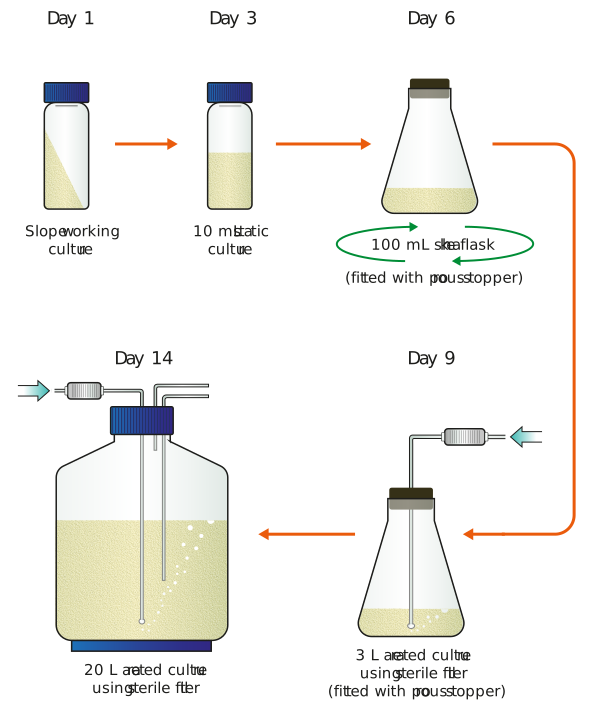
Figure: Scheme for laboratory propagation of yeast
Conventional laboratory equipment, either glass or plastic, is used for most stages. A medium of simple sugar, yeast extract and salts is used, except for the last stage where wort is normally used. A reasonably warm temperature (20-25 ºC) is also used to ensure short cycle times. Good growth is encouraged by making sure that conditions are continuously aerobic.
It is essential to ensure that all operations are performed with strict aseptic control since any failings at this stage will mean that the whole culture has to be discarded.
The terminal phase requires a specialised piece of equipment because it has to be suitable for growing yeast, for transporting the culture into the brewery and transferring it, aseptically, into the first brewery propagation vessel. This means that it will usually be made from stainless steel, and since a typical capacity will be around 20 L, it requires a system for efficient oxygenation. The following diagram shows the features of a flask suitable for this task:
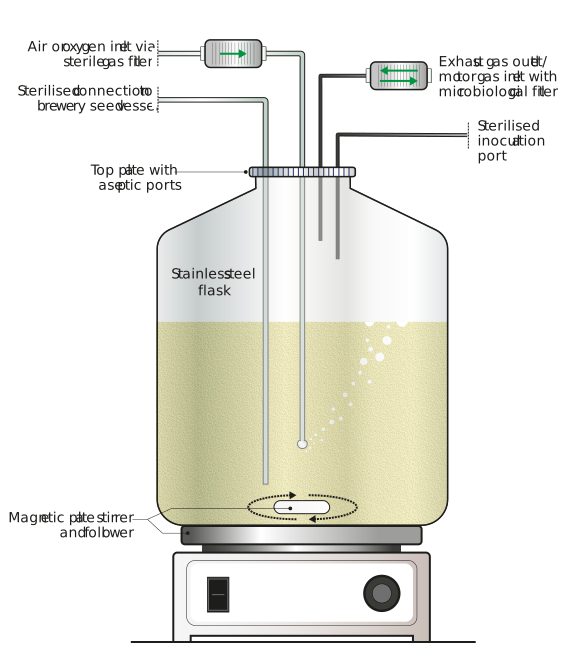
Figure: Features of a flask used for the last stage of laboratory propagation
The process relies mainly on the principles of quality assurance, which is necessary since there is little time for quality control. Processes should be robust enough to guarantee that the master culture has the correct identity and is pure – it should have been tested via genetic fingerprinting and conventional microbiological methods.
The culture should meet the necessary quality criteria providing all the proper aseptic precautions have been taken in all steps of the propagation process. The purity of the culture may be tested in the later stages of propagation, but this will be for historical purposes only.