
Lesson 10 - Yeast Unit Final SAQ
You have now completed the Yeast Unit. Here you will now have the opportunity to test your knowledge with a last set of self-assessment questions.
Suggested Response - Q1
***Answer both parts of this question
a) Yeast cultures used in brewing are a collection of clones. What does this mean?
b) Using a suitable diagram, outline the stages of the cell cycle and describe how these clones arise when yeast grows.
Response:
a) Clones are a collection of cells with identical genomes. This is the same definition that might be given to a pure culture. In brewing, where pure cultures are used, it is assumed that all the cells are identical, at least from the point of view of genotype.
b) Saccharomyces yeast strains multiply by a process called budding, in which a new smaller daughter cell develops from the parental mother cell. This can easily be seen under a good quality light microscope.
The process can be seen in the following diagram:

Figure: The outward signs of budding in Saccharomyces yeasts
In the process of budding, the DNA present in the chromosomes of the yeast nucleus is duplicated, and an exact copy passes from the mother cell to the daughter – this is why they are clones. This process is called mitosis and is the same as what happens when the cells divide in multi-cellular organisms. It is an example of asexual reproduction.
The sequence of events is called the yeast cell cycle.The events are summarised in the following diagram.
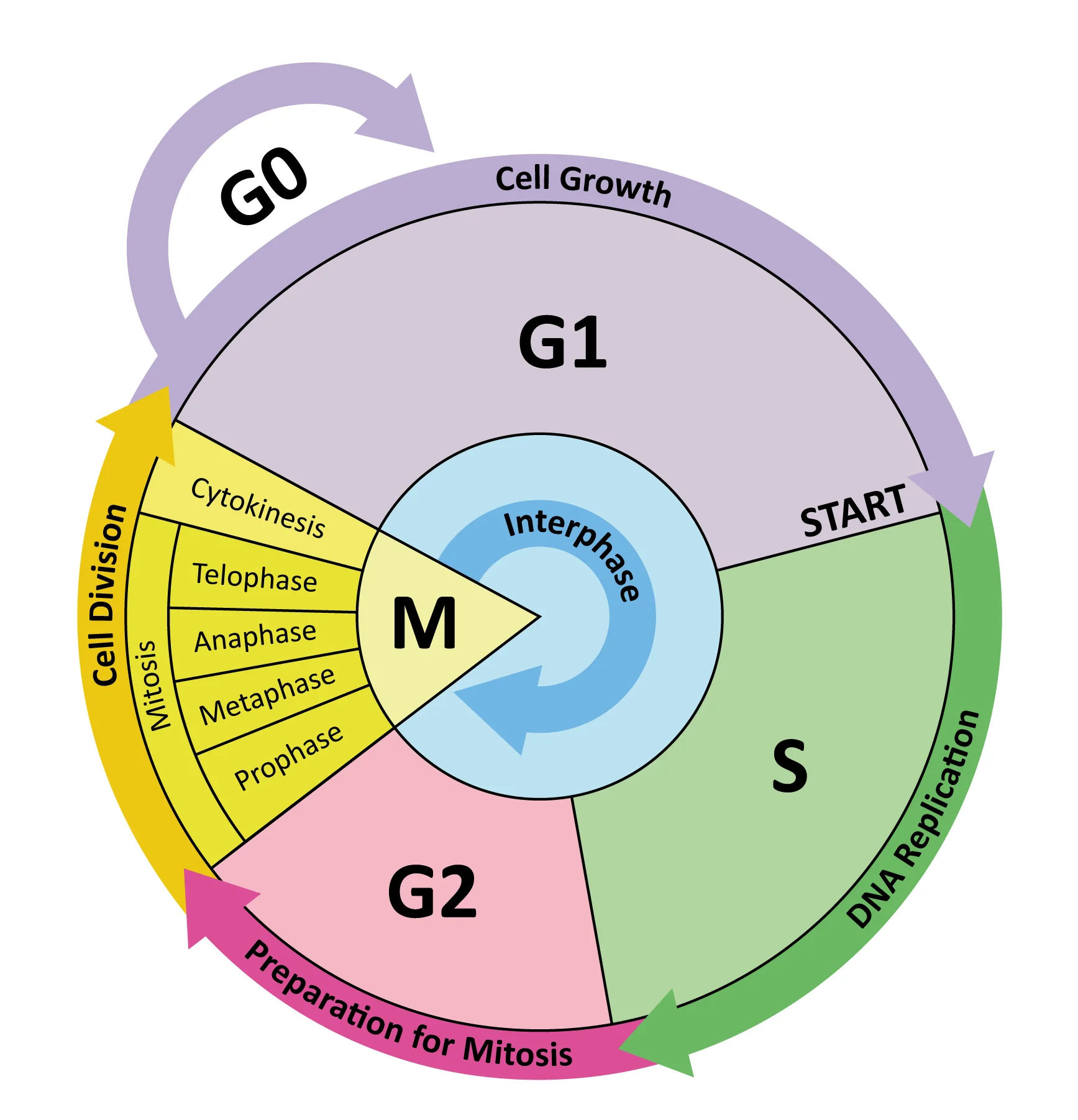
Figure: The yeast cell cycle
The process is managed by a cellular structure called the spindle body. The structure is a series of microtubules to which the chromosomes become attached; it physically moves the duplicated chromosomes around the cell as required in the different phases of the cell cycle.
G1
G1 is the phase in which yeast cells in an active fermentation spend the majority of their time. The G stands for gap because although there is plenty going on, the cell is not in the process of budding. During G1, cells increase in size, and gather the resources required to start budding. Towards the end of G1, the cell reaches a decision point. In order to commence budding it needs to be satisfied that the following conditions are met:
- Cell is sufficiently large
- Previous round of cell division is complete
- Cell contains sufficient sterols
- Cell is not subject to environmental stresses (osmotic pressure, high temperature, high pressure etc.)
- Sufficient nutrients are available
START
If these conditions are met, a milestone called START is reached and budding commences. If the START conditions are not met, for example if an essential nutrient is absent, the cell moves into a holding phase called G0.
G0
In G0 the cell’s metabolism is adjusted to shut down all non-essential pathways, and others are switched on. This gives the cell the best chance of withstanding a period of starvation. Yeast cells held in storage vessels are in G0.
S (not to be confused with START)
The S phase gets its name from the fact that it is the phase in which DNA synthesis occurs. During S, an area of the cell wall is broken down. New wall material and the underlying membrane are synthesised, and a bud begins to emerge. There is a hive of activity underneath the area where the bud is being formed. Microtubules in the cell form a skeleton along which vesicles containing enzymes and building blocks of the growing bud are transported. This requires energy. An osmotic effect causes the membrane to push against the wall. As the wall becomes weaker, this pushes the emerging bud out. As the bud grows in size, the DNA in the mother cell’s nucleus is replicated, as is the spindle body, which is a structure made up of microtubules in the cell nucleus. The spindle body holds the chromatids (the replicated strands of each chromosome) and will physically moves them when required.
G2
G2 is also known as the post synthetic gap phase because DNA synthesis is complete. G2 extends from S to M and during this phase the cell prepares for mitosis by synthesising proteins. The yeast’s bud also grows significantly.
As we can see on the cell cycle figure G1, S and G2 are the stages of interphase.
M
M stands for mitotic phase which includes mitosis and cytokinesis. M can be broken down into four stages:
- Prophase
- Metaphase
- Anaphase
- Telophase
During mitosis the chromatids are moved apart by the spindle bodies, the nucleus divides and the new nucleus moves into the bud.
Cytokinesis
In cytokinesis, the mother and bud separate. The name cytokinesis translates roughly from the Latin as cell movement. Some scientists do not class cytokinesis as part of the M phase.
Immediately before the mother and daughter cell separate, a ring-like structure develops, which eventually closes the aperture between the two cells. In the mother, this structure is rich in a carbohydrate called chitin. The chitin leaves a characteristic bud scar. The corresponding part of the daughter cell does not contain chitin and is called the birth scar.
Budding is an example of mitosis where, if it works properly with no errors occurring, an exact copy of the genome is made. Mother and daughter cells are genetically identical and are, therefore, clones. If any errors occur in the process, this is called a mutation and the daughter is genetically different from the mother.