
Lesson 10 - Yeast Unit Final SAQ
You have now completed the Yeast Unit. Here you will now have the opportunity to test your knowledge with a last set of self-assessment questions.
Suggested Response - Q3
***What effects do sugar and oxygen have on the growth and metabolism of Saccharomyces yeast? Illustrate you answer with diagrams showing how brewing yeast generates and conserves energy, as well as maintaining redox balance when growing on wort.
Response:
Saccharomyces yeasts are Crabtree positive; this means that in the presence of a simple sugar, such as glucose, metabolism is always fermentative. This is the case even if oxygen is also present.
The result is that energy in the form of ATP (adenosine triphosphate) is generated solely by glycolysis. All of the energy requirements of the cell are satisfied by this route.
The glycolytic pathway is shown in the following diagram.
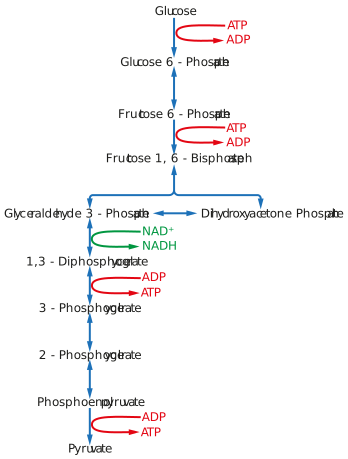
Figure: Reactions of the Embden-Meyerhof-Parnas (glycolytic) pathway
In the first part of this pathway, glucose, a hexose sugar, is converted into two three-carbon triose phosphate molecules. The phosphate groups are provided by the conversion of two molecules of ATP into ADP.
In the second part of the pathway, from triose phosphate to pyruvate, two molecules of ATP are formed. Since there are two triose phosphate molecules formed for each molecule of glucose that is oxidised, the net gain is two molecules of ATP.
Wort is a very rich source of sugar, and during fermentation, brewing yeast can easily meet all its energy requirements via glycolysis.
Sugar is the principal controlling factor; when present, all the genes involved in the respiratory pathways are repressed. The presence of oxygen does not override these effects.
Oxygen is required by brewing yeast to synthesise the essential membrane lipids, sterols and unsaturated fatty acids. In fermentation, these lipids are depleted in the anaerobic phase of growth. Oxygen is needed when the cells are re-pitched to replace these lipids. Since glucose is plentiful in the aerobic phase of fermentation, its presence represses the respiratory pathways, and even though oxygen is available, glycolysis remains the only route for ATP generation.
Under fermentative conditions (the usual redox-balancing route of reduction of oxygen to water) cannot occur because of the repressive effects of sugar. The alternative method that is used is the formation of acetaldehyde and its reduction to alcohol in a redox step catalysed by NAD-linked alcohol dehydrogenase.
A proportion of the carbon flowing from pyruvate is converted into acetyl-Coenzyme A. Many pathways begin with acetyl-CoA; collectively these contribute to new yeast biomass. Under respiratory conditions, acetyl-CoA is formed from pyruvate via the enzyme pyruvate dehydrogenase. The gene coding for this enzyme is also repressed under these conditions, and an alternative route is used in which acetaldehyde is converted into acetate and then acetyl-CoA.
The routes leading from pyruvate are shown in the following diagram:
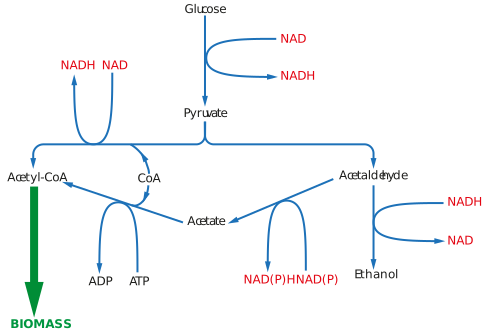
Figure: Carbon flow through pyruvate