
Lesson 10 - Yeast Unit Final SAQ
You have now completed the Yeast Unit. Here you will now have the opportunity to test your knowledge with a last set of self-assessment questions.
Suggested Response - Q2
**With the help of a diagram describe the features of a vessel suitable for the storage of pitching yeast slurry. Explain how you would analyse a sample of yeast taken from the vessel to determine the total and viable yeast concentration using a light microscope.
Response:
The essential features of a vessel suitable for storing pitching yeast slurries are shown in the following diagram.
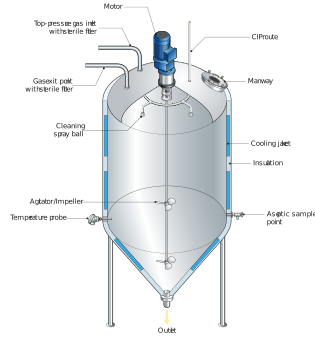
Figure: Diagram of a yeast storage vessel
Modern storage vessels are made from stainless steel. They are cooled via external jackets. Vessel contents are made homogenous using a low speed and a low shear mechanical stirrer. Homogeneity is essential for sampling and helps in temperature control by ensuring efficient heat transfer; this prevents the yeast from settling out.
Good hygiene is essential, and vessels are connected to a single-use CIP system. Prevention of contamination is helped by top-pressuring with an inert gas, either CO2 or nitrogen, a steam sterilisable aseptic sample tap and microbiological filters on gas inlets and outlets.
Accurate metering of the yeast slurry is via load cells or an in-line flow meter.
Manual determinations of yeast cell concentration and viability are carried out using a light microscope and a suitable viability stain such as methylene blue.
A representative sample of slurry is first diluted to reduce the cell concentration to a level low enough to allow counting. The diluted sample is mixed with the viability stain and loaded onto a haemocytometer microscope slide. This, as the name suggests, was designed to count blood cells, but is suitable for any other cell that can be easily seen under a good quality light microscope. It consists of two chambers of known volume. Each chamber has a grid etched on the surface, which helps when carrying out the cell count.
The viability dye stains live and dead cells in different colours. In the case of methylene blue, viable cells are thought to take up the stain and change the dye to its colourless leuco form.
A representative number of cells are counted, typically around 300, and the total number and those stained blue (dead cells) are recorded. Since the volume of the counting chamber is known, and with a correction for the dilution factor, the total and viable cell count in the original slurry can be calculated.