
Lesson 5 - Wort Separation Technology SAQ
This lesson allows you to test yourself on the material covered in Lesson 4 on ‘Wort Separation Technology’ and determine the level to which you have attained the outcomes.
Suggested Response - Q8
**The diagram below is an annotated trend graph of a lauter tun wort collection. Explain what was happening, and how the lauter tun was responding to process conditions.
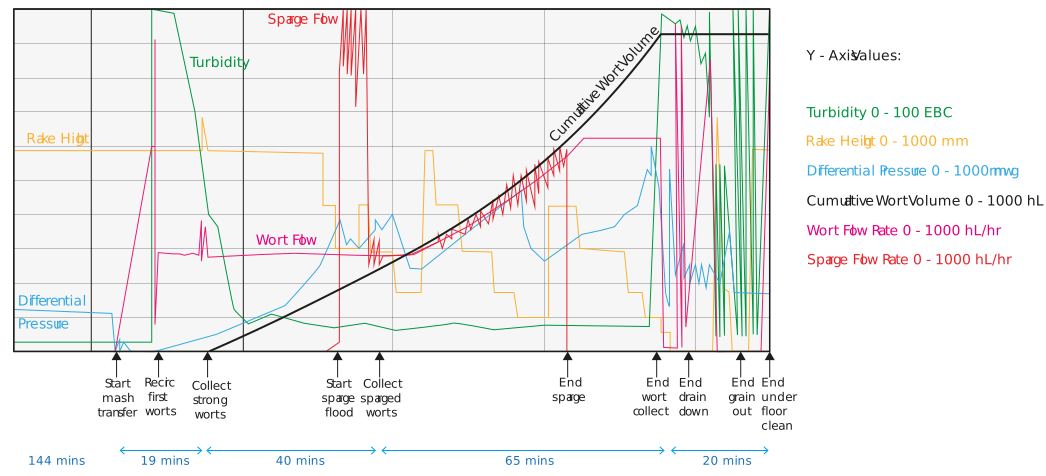
Figure: A trend of lauter tun wort collection
The automated lauter tun is pre-programmed for specific flow rates at specific volumes of wort collected. It will follow this programme unless DP becomes too high, in which case it will stop and execute a deep bed rake. In this example, the wort collection flow was continuous, and no deep bed rake was employed.
Just prior to mash transfer, there was an underlet of hot water to just cover the false floor. During receipt of the mash, the rakes were in the raised position, and DP was low.
Recirculation of first worts started at the flow rate programmed for strong worts collection (275 hL/h). The DP was gradually rising. The wort turbidity in the outlet main was initially very high, but within a few minutes it fell to below 50 EBC. At this point, strong worts collection was started.
By the time 50 hL of strong worts had been collected, the haze had fallen to below 10 EBC, and remained there for the rest of wort collection. The DP continued to rise steadily.
At a cumulative wort volume of 150 hL, the DP had risen to 250 mmwg. This triggered the rig to start rotating and lower the rakes into the grain bed to counteract the increasing DP. (The rakes lower according to the DP. For each band of DP, there is a nominated rake height. Rake height moves down with increased DP; rake height moves up with decreased DP).
In this instance, the first rake height of 425 mm did not halt the increase in DP. As the DP rose to 350 mmwg, the rake height reduced to 300 mm. This rake height was successful at reducing the DP. As the DP reduced back to the previous DP band, the rake height returned to its previous position of 425 mm.
At a cumulative wort collection volume of 200 hL, the sparge was started. This was applied at a high flow rate of 900 hL/h to quickly replace the wort volume that had been removed. This was achieved by the time the wort collected volume had reached 250 hL. The sparge flow rate was then set to match the wort collection flow rate, until the sparge volume was completed.
Strong worts collection continued at a fixed flow rate of 275 hL/h until the cumulative collected wort volume had reached 300 hL. At this point, the sparged wort gravity and its viscosity were reducing, allowing a higher flow rate. The wort collection flow rate was gradually ramped up to achieve a maximum flow of 625 hL/hr by the time the wort collection volume had reached 700 hL. The rest of the wort collection was done at this high flow, to achieve the final volume of 920 hL. This final 220 hL of wort collection at high flow drained the lauter tun to almost empty.
The sparge flow rate had also been increased to match the wort flow rate. Its volume was completed at a cumulative wort collection volume of 625 hL.
Throughout wort collection, the rakes were used in response to DP. As the sparged worts flow rate was increasing, the DP had climbed to 500 mmwg. The rake height was then lowered to 100 mm above the false floor, which successfully reduced the DP without detriment to wort clarity.
At the end of wort collection, 920 hL of wort had been collected. The residual last runnings were directed to drain. The rakes were operating at false floor level, to help drain down the grain bed to an acceptable level of moisture.
To discharge grain, the rig was raised out of the grain bed, and a plough bar was lowered to the bottom of the rakes. This rotating plough bar gradually lowered into the grain, and pushed it forwards and outwards to the spent grain opening at the periphery of the lauter tun floor.
As the descending plough bar reached the false floor, the under-floor jetting nozzles were activated to flush away any debris or dough that may have been under the false floor. The rakes were raised to their resting position. All was ready for the next brew.