
Lesson 8 - Milling Lesson Final SAQ
This lesson allows you to test yourself on the material covered in all previous milling lessons and determine the level to which you have attained the outcomes.
SAQ Suggested Response – Q3
***Sketch the layout of a typical malt handling plant at a large brewery. Using bullet points, summarise the requirements of the main pieces of equipment. Explain how each element is operated safely.
Response:
Diagram of a typical malt handling plant:
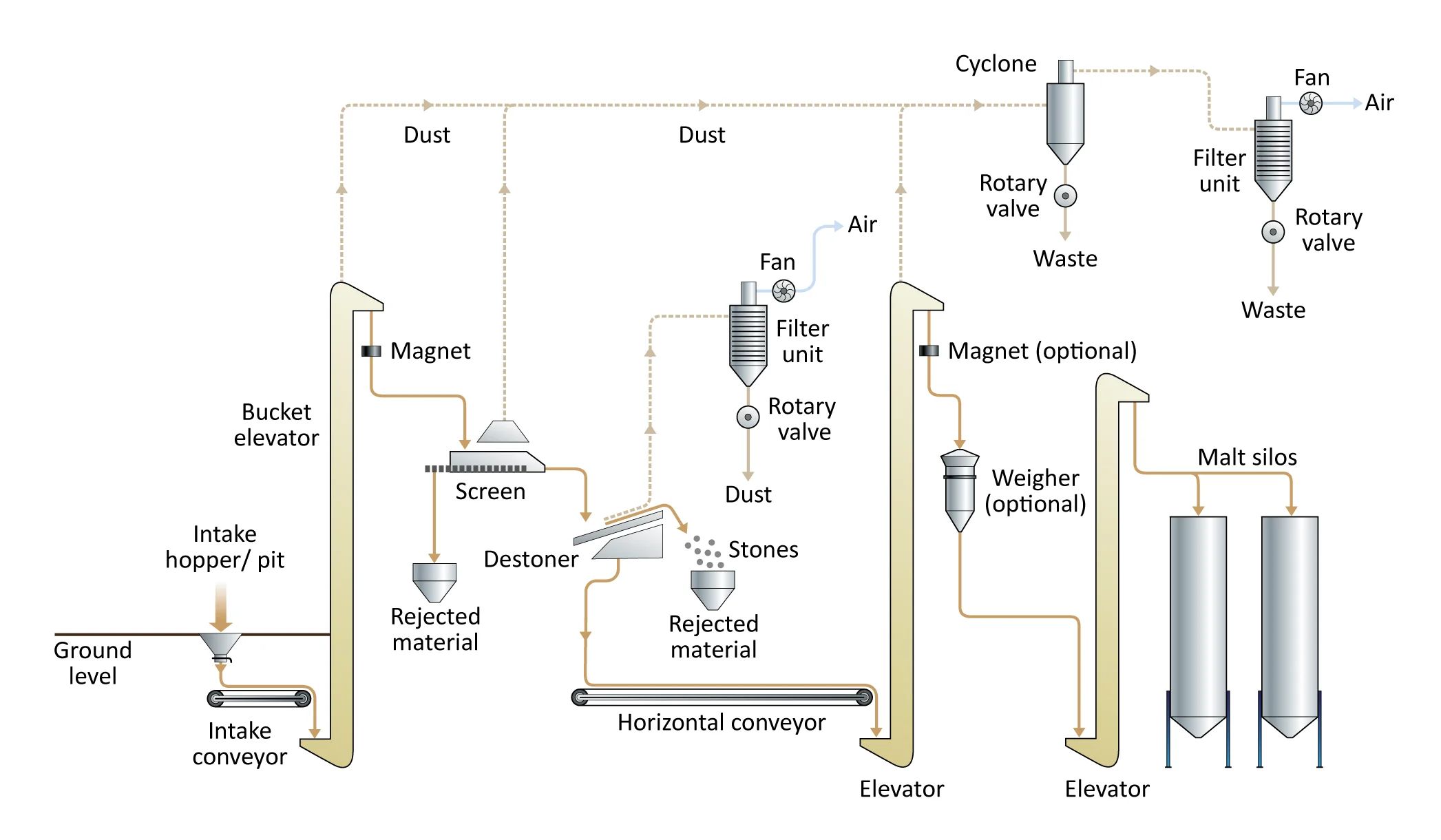
Main equipment:
-
An intake pit or hopper
-
Magnets
-
Bucket elevators
-
Conveying systems (pneumatic, drag chain, pipe chain and disc, belt, screw)
-
A dust aspiration system
-
Silos
-
A destoner
-
Malt screening
-
Malt weigher(s)
-
Manual dust cleaning and collection systems
Now we can summarise the requirements of each and detail how to operate them safely.
An intake pit or hopper
Requirements:
-
Prevents ingress of pests, water, oil, and fuel from transport
-
Located in an area that is easily accessible by transport
-
Screened to prevent large foreign objects from entering system
-
Able to comfortably hold accumulations of malt
-
Accessible for cleaning and maintenance
-
Designed and operated to empty completely at the end of the delivery
-
Easily cleaned
Safe operation of an intake pit or hopper is ensured by designing it with interlocking guarding that prevents staff entanglement in the conveyor. It should also be located in an area where drivers or staff can work while protected from traffic movements in the vicinity. The intake point should be under aspiration to prevent dust emissions. The hopper/pit and ancillary equipment should be earthed to prevent sparks and subject to regular checks for the risk of explosive atmospheres.
Magnets
Requirements:
-
Designed so that a thin stream of grain flows across them
-
Strong enough to catch and retain ferrous material
-
Located before any equipment where sparking is possible
-
Self-cleaning, or easy to remove and clean
To operate safely, a magnet needs to do its job! If it is a fixed magnet, it should also be cleaned regularly so that it is not overloaded and to prevent any material that is caught from being swept off by the flow or malt.
Bucket elevators
Requirements:
-
Move malt vertically between processes without damaging malt
-
Malt must be metered gently into the base of the elevator to prevent choking (overfilling)
-
Should not be started when full but instead filled when in motion
-
The bottom of the elevator should be accessible for cleaning on a regular basis to remove old grains and dust
To ensure safe operation, a rotation/speed sensor should be fitted to the bottom pulley to detect any belt slippage. Regular maintenance of belt tension and inspections of bucket condition are necessary. Belt alignment detection is also necessary to guarantee safe operation. Dust aspiration and explosion relief is essential (or a fire suppression system must be used). The elevator should be earthed to prevent sparks and should be subject to regular checks for the risk of explosive atmospheres.
Conveying systems (pneumatic, drag chain, pipe chain and disc, belt, screw)
Requirements:
-
Move grain from one process to another
-
Cause minimum damage to grain
-
Be empty after use
-
Easily cleaned and maintained when necessary
To ensure safe operation, regular maintenance is necessary. Dust aspiration and explosion relief is essential (or a fire suppression system must be used) for most systems. The conveyor should be earthed to prevent sparks and it should be subject to regular checks for the risk of explosive atmospheres. For screw conveyors and chain and flight conveyors, jam switches are also required.
A dust aspiration system
Requirements:
-
Removes dust from malt handling system, silos, and mill
-
Maintains negative pressure in system
-
Self-cleaning or easy to clean manually
-
Waste dust should be collected to allow for safe reuse or disposal
The dust aspiration system collects dust from the malt handling equipment and prevents it from escaping into the workplace. So its operation is essential when the malt handling plant is running. It is therefore best to have backups for key parts of the system and to have these running alternately. The collected dust from the aspiration system needs to be removed and disposed of so that it can remain in operation. The system also needs to be checked for accumulations of dust and maintained on a regular basis. In addition, it should be earthed in order to prevent sparks and should be subject to regular checks for the risk of explosive atmospheres.
Silos
Requirements:
-
Store grain without causing deterioration
-
Allow for ventilation of the grain and cooling where required
-
Prevent water and pest ingress
-
Allow sampling of the grain
-
Allow safe and effective fumigation (if a fumigation silo)
-
Allow grain to empty through mass flow
-
Enable the grain to slip easy out of the silo, so complete emptying is possible
-
Accommodate the top cone of malt due to its angle of repose
-
Allow the contents of the silo to be determined
To operate silos safely, we need to ensure that they are aspirated in order to minimise dust. Access to the silos must be restricted to prevent staff working from accessing heights. Where working at height is required, the appropriate platforms and guarding must be provided. Silos should also be earthed to prevent sparks and should be subject to regular checks for the risk of explosive atmospheres. Silos are confined spaces with the hazard of free-flowing solids, so access to the inside of silos should be managed using a permit to work and an attendant system. Rescue and safe evacuation plans must also be in place. Explosion panels are also required.
Destoner
Requirements:
-
Removes foreign material with a density greater than that of malt
-
Be installed before any equipment where sparks are likely
-
Self-cleaning or easy to clean manually
-
Collects foreign material for safe disposal
To ensure safe operation, regular maintenance is necessary. Dust aspiration and explosion relief are essential. Destoners should also be earthed to prevent sparks and should be subject to regular checks for the risk of explosive atmospheres. They should have interlocked guards to prevent staff or maintenance contractors from becoming entangled in moving parts. Where noise levels exceed work place exposure limits, they should be housed in soundproof rooms or hearing protection should be mandatory.
Malt screening
Requirements
-
Removes foreign material that is larger or smaller in size than the specification for the malt
-
Be installed before any equipment where sparks are likely
-
Self-cleaning or easy to clean manually
-
Collects foreign material for safe disposal
Malt screening machines operate similarly to destoners, therefore what we need to do to ensure safe operation is the same as detailed above for destoners.
Malt weighers
Requirements
-
Accurately weigh the malt
-
Cause the minimum damage to the malt
-
Self-cleaning or easy to clean manually
-
Easy to calibrate and check calibration
To ensure safe operation, regular maintenance, dust aspiration, and explosion relief is necessary. Malt weighers should also be earthed to prevent sparks and should be subject to regular checks for the risk of explosive atmospheres.
Manual dust cleaning and collection systems
Requirements
-
Easily accessible through the malt handling area
-
Remove dust effectively
-
Easy to keep tidy
To operate a manual dust cleaning system safely, it must not create trip hazards while in use. Breathing protection must be worn by anyone operating the system and anyone working in the area where it is in use, as it may create a dusty atmosphere.