
Lesson 7 - Brewing Product Water Final Treatment SAQ
This lesson provides the opportunity for you to test yourself on the material covered in Lesson 6 (Brewing Product Water Final Treatment) and determine the level to which you have attained the expected outcomes.
Suggested Response - Q2
*Membrane filtration is one method for treating water. Please provide short answers to the following questions:
a) Describe the principle of membrane filtration (use a diagram to help explain). List the four main types of membrane filtration used in water treatment. Your answer should refer to pore size and operating pressures.
b) What is the main reason for using microfiltration?
c) What is the principle of reverse osmosis? Explain how a RO plant works in water treatment.
Response:
a) Membrane filtration utilises a semi-permeable membrane, which means that the membrane will let water and certain ions and other molecules through but will retain others. This prevents them from passing through the filter – depending on their size compared to the pore size of the semi-permeable membrane.
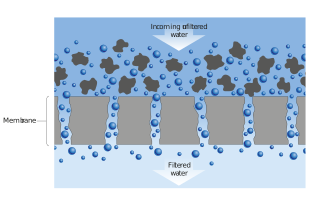
The four main types of membrane filter are:
- Microfiltration (0.1 μm and 0.7-4 bar)
- Ultrafiltration (0.01 μm and 2-7 bar)
- Nanofiltration (0.001 μm and 6-10 bar)
- Reverse osmosis (0.0001 μm 10 to 20 bar, even up to 82 bar for sea water)
b) Microfiltration removes bacteria and yeast from the water. A sterile filter is sized at 0.45 μm and falls under microfiltration.
c) Osmosis is the diffusion of water across a semi-permeable membrane from a low solute concentration to a high solute concentration. Reverse Osmosis means that we need to apply enough pressure on the concentrated side to overcome the osmotic pressure and concentrate the solutes even more.
The membranes are housed in a cartridge, which uses cross-flow filtration. The feed water passes through the filter with two outlets – the filtered water goes one way and the contaminated water goes another way. The feed water is pumped in at high pressure (to overcome the osmotic pressure) and the water molecules pass through the membrane. This water is known as the permeate (which is the demineralised water or product water) and is then drawn off to one side. The minerals are stopped and pushed into the rest of the water. This is known as the reject or concentrate stream. This reject water is then either sent to drain or fed back into the feed water supply to minimise water loss.