
Lesson 2 - Brewing Water Sources and Treatment
This lesson introduces water as an ingredient for brewing. It explores the water cycle, sources of water and potability standards. It also examines some characteristics of water (hardness and alkalinity) and their effects on the brewhouse. Finally, the lesson investigates the methods of water analysis.
Disinfection
Both sewage and animal waste pose the greatest risk to potable water quality, as these contaminants can carry diseases.
To overcome this risk, water is disinfected. Disinfection uses chemicals or UV light to kill, or inactivate, pathogenic micro-organisms. Chlorine (Cl2) is the most widely used disinfectant for large municipal water supplies.
Chlorine sources are usually liquefied chlorine gas or sodium hypochlorite solution (NaOCl). The chlorine dissolves in water (H2O) to form hypochlorous acid (HOCl) and hydrochloric acid (HCl).
Cl2 + H2O ↔ HOCl + HCl
HOCl can dissociate into hydrogen (H+) and hypochlorite (OCl-).
HOCl ↔ H+ + OCl-
Hypochlorous acid is a more powerful disinfectant than hypochlorite. Therefore, the pH can be controlled at between 5 and 6 to favour hypochlorous acid formation.
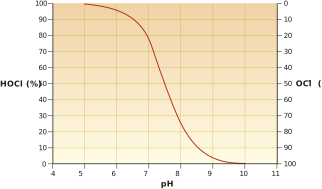
Figure: The effect of pH on hypochlorous acid and hypochlorite ion equilibrium
The World Health Organisation recommends that for the effective disinfection of drinking water “the pH should preferably be less than 8.0 and the contact time greater than 30 minutes, resulting in a free chorine residual of 0.2 to 0.5 mg/L”.
There is a risk of organic halogen compounds forming, such as trihalomethanes (which are possible carcinogens). These occur when chlorine reacts with organic matter in the water. Residual chlorine levels in the water thus need to be managed to prevent their formation. Excessive chlorine can cause undesirable taste and odours. It also carries a corrosion risk.
Once the water has been disinfected with chlorine, ammonia (NH3) can be dosed into the water. Ammonia reacts with the free chlorine to form chloramines (NH2Cl). Chloramines are not as effective as chlorine in disinfecting water, but they last longer and so can have a protective effect after initial disinfection by chlorine.
The advantages of chlorine treatment include:
- Low initial cost
- Low running costs
- Simplicity of handling
- Protection against re-infection
The disadvantages include:
- Gives an off-taste that requires carbon filtration
- Some organisms are resistant to chlorine
- Formation of organic halogen compounds
There are other forms of disinfection, but they will be covered in a later lesson that deals with ‘Brewhouse Product Water and Treatment’.
The figure below summarises the raw water treatment process:
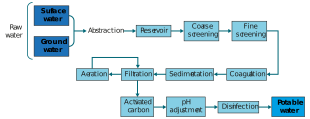
Figure: Schematic of raw water treatment
At the end of this raw water treatment, potable water is produced. But what does this really mean?
The World Health Organisation wrote the ‘Guidelines for Drinking Water Quality’, and individual countries have used these guidelines to set their own drinking water (potable water) standards.
The table on the next page shows an example of the legal potable water standards, as set by the UK. They are based on the European Drinking Water Directive 1998, together with their own national standards. Please note that this is for illustrative purposes and you are encouraged to obtain the potable water standards for your own country.
Other examples of potable water standards can be found online by searching for:
-
USA potable water standards
-
WHO potable water guidelines