
Lesson 2 - Brewing Water Sources and Treatment
This lesson introduces water as an ingredient for brewing. It explores the water cycle, sources of water and potability standards. It also examines some characteristics of water (hardness and alkalinity) and their effects on the brewhouse. Finally, the lesson investigates the methods of water analysis.
Water Sources
Water comes from a variety of sources, each of which can influence the characteristics of the raw water. To begin, let us take a very high-level look at the water cycle.
Water begins as pure water vapour in the clouds. It then condenses and falls to earth as precipitation (e.g. rain, snow, hail), forming a liquid on the earth’s surface. This surface water can ultimately trickle into rivers or lakes, but it could also trickle through the soil and into ground water.
Ground water can remain for many years (thousands) before ultimately making its way back into surface water in the form of a spring, river, lake or even the ocean. This water may then evaporate back into the atmosphere to start the journey again as water vapour.
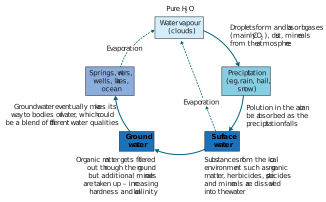
Figure: The water cycle from vapour to liquid to vapour again
Throughout the journey, the water absorbs many different compounds, both organic and inorganic. Depending on the final route (e.g. surface or ground water), the composition of the water changes, and its suitability for brewing will vary.
So, what does this mean for the brewer? Brewing water is water that is actually used for making the beer or is in contact with the beer during the brewing process (also known as brewing liquor or brewing product water). Brewing product water needs to be ‘potable’. Potable means that the water is safe to drink. The World Health Organisation’s 2017 report defines safe drinking water as ‘water that does not represent risk to health over a lifetime of consumption, including different sensitivities that may occur between life stages’.
In practical terms this means that potable water should be:
- Microbiologically free of pathogens: coliform bacteria (derived from digestive tract in animals and humans) indicate microbial purity with safety levels stipulated at 0 cells / 100 ml water.
- Colourless and clear: suspended solids can cause increased colour and turbidity.
- Tasteless and odourless.
- Of optimal pH: close to neutral pH (7.0).
- Free from heavy metal ions: all potable water should be free from such compounds.
Let us delve into the water cycle a bit deeper to see how the different water sources can impact our potable water criteria.