
Lesson 6 - Speciality Malt and Adjuncts Final SAQ
This lesson allows you to test yourself on the material covered in all previous adjuncts lessons and determine the level to which you have attained the outcomes.
Suggested Response - Q3
**Your brewhouse operator asks you why rice grits cannot be added to the mill alongside the barley malt before mashing.
a. What would your response be?
b. Briefly outline why adjuncts are used and explain their advantages and disadvantages.
Response:
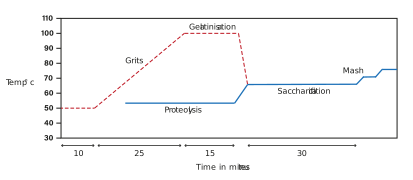
a. The starch granules of any cereal added to the mash need to undergo gelatinisation. This allows enzymes to access the starch molecule. Gelatinisation happens at different temperatures for different forms of starch.
Some cereals can be added to the grist to be mashed. Oats, wheat and rye can be added to the mash along with malted barley because their starch gelatinises at a similar temperature. Pre-gelatinised solid adjuncts can also be added to the mash since the starch is already accessible to the enzymes.
Rice grits have higher gelatinisation temperatures so they cannot be added to the mash directly. Rice grits require pre-cooking to gelatinise the starch, making it available to the starch degrading enzymes. Once the starch is gelatinised through pre-cooking in a cereal cooker, the slurry can be added to the mash for conversion.
b. Adjuncts can be used for:
- Affecting fermentability
- Influencing flavour
- Increasing brewhouse capacity
- Improving foam
- Improving flavour stability
- Improving colloidal stability
- Reducing costs
Some adjuncts improve drinkability. Rice and maize have been used for many years to produce light-bodied beers. Adjuncts can increase the capacity of a brewery without large capital expenditure. Brew lengths and gravities can be increased and brewhouse cycle times can be decreased due to less malted barley being used.
If adjuncts low in nitrogen are used, there is a risk of diluting free amino nitrogen (FAN), which can cause problems in fermentation. Yeast nutrients can be used to provide FAN and prevent these problems. Diluting protein can cause problems with foam stability but helps improve colloidal and flavour stability. Using adjuncts that provide proteins and glycoproteins can promote foam stability.
|
|
Advantages |
Disadvantages |
|
Non pre-gelatinised adjuncts |
- Cost effective - Some are a purer form of starch than malt - Some provide a little less cell wall material than malt - Some dilute malt flavour - Sorghum and maize adjuncts can provide FAN - Some improve foam - Rye and wheat provide different flavours |
- Maize and rice grits require dedicated equipment for storage and processing - Safety risk – dust explosions - Prone to fungal infection during storage, as the starch is exposed - Do not contribute husk for wort separation |
|
Pre-gelatinised adjuncts |
- More expensive than grits, but cheaper than liquid adjuncts - Can be milled with malt before mashing - Provide different flavour |
- Do not contribute husk for wort separation |
|
Liquid sugar adjuncts |
- Already in fermentable form - Can add directly to the wort kettle/whirlpool - Can increase capacity without capital cost - Can be used to adjust fermentability - Can provide colour and flavour |
- Specialised storage vessels that are heated to keep syrup viscosity consistent required - FAN dilution may require additional yeast nutrients to be added
|