
Lesson 5 - Adjunct Composition and Application SAQ
This lesson provides the opportunity for you to test yourself on the material covered in Lesson 4 (Adjunct Composition and Application) and determine the level to which you have attained the expected outcomes.
Suggested Response - Q5
**A new employee in your brewhouse indicates that although they understand how to use liquid adjuncts to increase throughput, they do not understand the difference between the various syrups. How would you explain it to them?
Response:
Liquid adjuncts or kettle adjuncts are a fermentable source of sugar that can be added directly to the kettle to achieve the required gravity. The first type of liquid adjunct is sucrose syrup, which is produced from sugar cane or sugar beet.
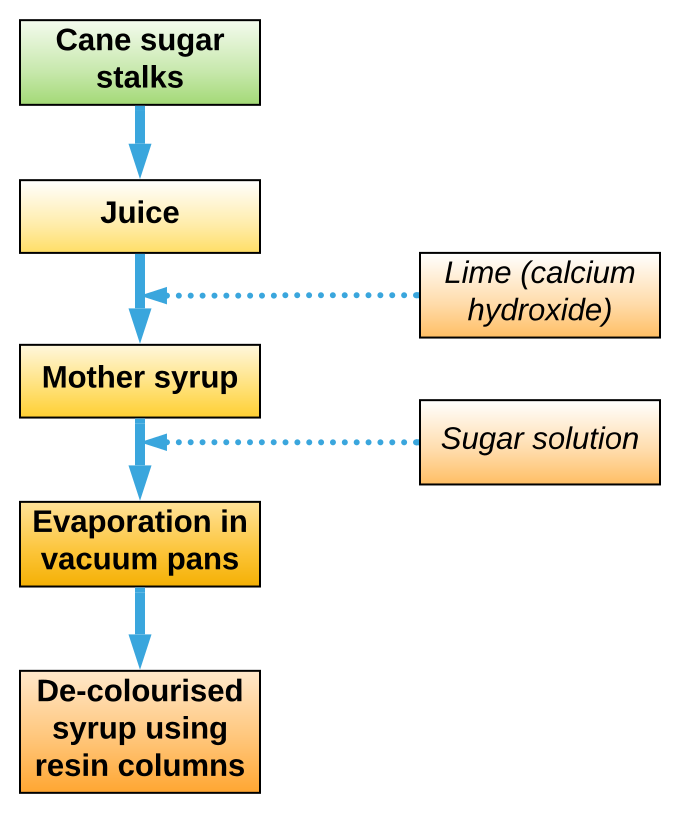
Figure: Production flow of liquid sucrose
The syrup is 99.7% pure sucrose, and is 100% fermentable. Sucrose is made up of fructose and glucose molecules; yeast converts these molecules to alcohol. This syrup is fully fermentable (it does not contain unfermentable sugars, thus produces more alcohol per kg than malt extracts) and contains no dextrins that contribute to mouthfeel; thus, making the final product lighter in body.
Dextrose and maltose syrups are also used in the brewhouse. Maize and wheat are commonly used to produce the syrups. The method followed will determine the carbohydrate profile of the adjunct. In other words, the levels of each type of sugar in the syrup.
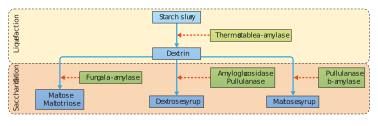
Figure: Industrial processing of starch into sugar syrups
During dextrose syrup production, amyloglucosidase produces glucose molecules from starch chains. Pullulanase (limit dextrinase) breaks the bonds where the starch chain branches out. This results in straight chain starches that the amyloglucosidase can break down, making the syrup more fermentable. Maltose syrups use limit dextrinase and  -glucanase to produce fermentable sugars. A typical brewing sugar will contain a mixture of dextrose and maltose compared to a high dextrose, where dextrose will be the major sugar.
|
Unit of measure |
Brewing syrup |
High-dextrose syrup |
High-maltose syrup |
|
|
Refractive index (45˚C) |
|
1.4969-1.5002 |
1.4633-1.4656 |
1.4923-1.4956 |
|
Sulphated ash |
%, max |
0.4 |
0.05 |
0.05 |
|
Conductivity |
µS/m |
< 600 |
< 15 |
65 |
|
Calories |
kJ |
335 |
284 |
324 |
|
Density 49˚C 60˚C |
g/cm-3 |
1.425934 1.418745 |
1.326478 1.320487 |
1.4131 1.4064 |
|
Viscosity 49˚C 60˚C |
cP |
6,000 2,500 |
57 38 |
4,200 1,600 |
|
Typical carbohydrate profile |
% dry basis |
|
|
|
|
Dextrose |
|
36 |
95 |
12 |
|
Maltose |
|
31 |
3 |
43 |
|
Maltotriose |
|
13 |
0.5 |
20 |
|
Higher saccharides |
|
20 |
1.5 |
25 |
|
Total fermentables |
|
78-82 |
98.5 |
73-77 |