
Lesson 8 - Malt Final SAQ
This lesson allows you to test yourself on the material covered in all previous malt lessons and determine the level to which you have attained the outcomes.
Suggested Response - Q7
*** Although the mashing operation was problem free, after the completion of the mash stand, the wort has tested positive for starch.
(a) What could be the problem?
(b) Explain which enzymes are active during the germination phase and how they expose the starch for enzymatic breakdown.
Response:
(a)
The test for starch is conducted using an iodine solution. If the mash turns purple or black, this indicates that starch is still present. This will be covered again in the mashing unit.
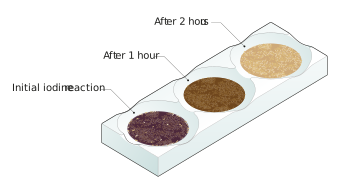
Starch test in mash tun
The α-amylase activity can be determined by measuring the time it takes to break down a standard starch solution to a specific colour standard, using iodine as an indicator. A result of 30-50 DU for an all-mash mash is normal, but if you are using other adjuncts in the mash, you should expect higher values.
There could be reduced enzyme activity due to a lack of enzymes in the malt, but this would have been noticeable on the CoA, within the DU and DP results. The mashing operation did not contribute to the lack of enzymes; the malt CoA would clearly indicate if the enzyme level is low, hence the starch must not be available for conversion.
The gelatinisation temperature of the starch is too high. The enzymes can only attack the outside of the starch granules, unlike gelatinised starch, where the chains would have opened, exposing the amylose and amylopectin to the amylases.
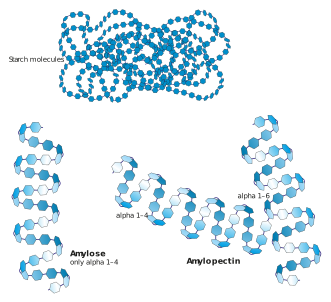
(b)
Germination starts during steeping. It initiates the biological reactions that will modify the starchy endosperm and supply enough nutrients to the growing embryo. Some of the enzymes are synthesised during the modification process, like α-amylase, limit dextrinase and endo protease. Some of the enzymes are present in the starchy endosperm and are activated during modification. They are β-amylase, endo β-(1,3)(1,4) glucanase, endo β-(1,3) glucanase, phytase, lipase and pentosanase.
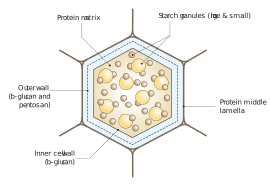
The starch granules are surrounded by a protein matrix and cell walls
The cell walls will stop any enzyme activity within. The wall made up from pentosans and β-glucans will need to be broken down first.
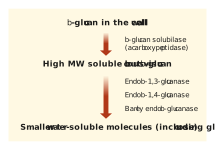
Proteases will attach themselves to the middle lamella and start to break down both the proteins in the cell wall and the protein matrix surrounding the starch granules. Next, the α- and β-amylase will start to break down the starch into sugars. There are two types of starch granules. The starch granules differ in size, with the larger being disc shaped, and the smaller granules being spherical. The small starch granules require higher temperatures to gelatinise; this must be considered to avoid it negatively impacting the extract (sugar) achieved during mashing, however, most small granules do not survive the malting process