
Lesson 3 - Barley SAQ
This lesson provides the opportunity for you to test yourself on the material covered in Lesson 2 (Barley) and determine the level to which you have attained the expected outcomes.
Suggested Response - Q4
**Label the following diagram; define the major components within the diagram. Evaluate the importance of each component to malting and brewing processes.
Response:
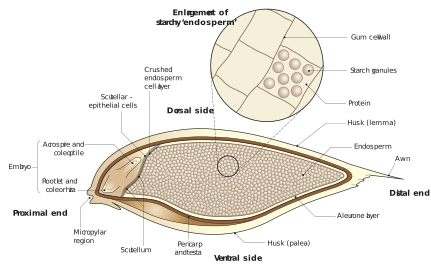
Husk
Because it is mechanically tough, it protects the grain from physical harm and also helps slow insect damage. The husk also provides a natural defence against mould growth during both barley and malt storage. In the brewhouse, husk forms the filter bed in the wort separation vessel. The figure below shows each layer of the barley kernel.
Aleurone layer
This is one of two living parts present within the matured grain. This layer is essential for producing the relevant enzymes responsible for endosperm modification. Activated by gibberellic acid produced in the embryo, the aleurone layer synthesises enzymes that are critical to breaking down the endosperm such as  -amylase. It also activates enzymes such as
 -amylase which is located in the starchy endosperm.
Endosperm
The endosperm is crucial to the brewing process. Starch is converted into fermentable sugars in the mash vessel. The maltster ensures that the malting process makes the starch accessible to starch degrading enzymes.
Embryo
The embryo contains living cells and the precursor tissue to the first leaf, stem and roots.
The embryo must be alive and intact for the grain to germinate. Ungerminated barley is not malt so we don't want it in our malt delivery! It is poorly friable, provides very little extract and contributes high levels of β-glucans.These are just some of the relevant points but this is not an exhaustive list. Keep this question in mind as you explore further malting and mashing lessons!