
Lesson 2 - Classification and Properties
In this lesson we will discuss what materials of construction are and why a better understanding of them is important to us. We examine the general classification of materials and highlight some of the most important ones in each relevant class. We will review the properties of materials and go into greater detail on these where required. To conclude, we focus on three things that can impact materials greatly: corrosion, degradation and welding.
Welding
Welding is used extensively to join metals together as it provides a permanent bond that is strong.
In this lesson, we will not be going into detail on the welding process itself but will rather focus on what happens to the metal in and around the weld, which has important implications for our brewing equipment. Let us now briefly look at the basics of welding.
Welding basics
Welding employs very high temperatures to melt metal parts together. This temperature differs for each type of metal. Upon cooling they fuse together, creating a permanent join. In some cases, only the base metals are welded, and in other cases, a filler material is used.
There are a number of welding techniques. The most common energy sources are either chemical, in the form of a gas flame, or electrical, in the form of an electrical arc.
Arc welding uses a welding power supply to create an electric arc between the metal to be welded and the electrode. The power source can be direct current or alternating current, depending on the type of welding. The physical gap results in a resistance to current flow, and this melts the metals to create the joint. The electrode can act as the welding rod and be consumed, or if the electrode is not consumable, a separate welding or filler rod is required.
Gas welding is usually oxyacetylene welding which uses pure oxygen and acetylene to create a flame that burns in the region of 3100 °C.
The main enemy of any type of welding is oxygen. The welding site can be shielded with inert gas or with a flux that forms part of the welding rod and creates a carbon dioxide blanket. The flux can also lay down slag which covers the weld and protects it.
Common types of arc welding
The table below gives a summary of the most common types of arc welding:
Table: Common types of welding
|
Welding type |
Electrode/filler |
Gas |
Uses and properties |
|
Arc Welding Shielded Metal Arc Welding (SMAW) ‘stick welding’ |
Consumable electrode with filler metal and flux |
None |
Steel structures Industrial fabrication Home welding Easy process Slag removal and clean-up required |
|
Metal Inert Gas (MIG) Gas Metal Arc Welding (GMAW) |
Continuous feed wire forms the electrode |
Yes |
Mild steel Stainless steel Aluminium |
|
Flux-cored arc welding (FCAW) |
Continuous feed wire covered with flux |
Not normally |
Same as for MIG |
|
Tungsten inert gas (TIG) Gas Tungsten Arc Welding (GTAW) |
Non-consumable electrode made of tungsten with a separate filler rod |
Yes |
Excellent for thinner materials Stainless steel Good quality welds High skill level Very little clean-up required |
What type of welding would you recommend for use with brewery equipment? How would you want a weld to be? Clean good quality welds on stainless steel that is often thin walled? It has to be TIG!
What happens in the weld?
There are three main zones in the weld. The fusion zone is where the metal melts and then solidifies again. The heat-affected zone is the area adjacent to the fusion zone where the metal experiences temperatures that although below melting, still result in significant metallurgical changes. The base metal zone is the zone not changed in any way by the welding. These areas are shown in more detail in the figure below:
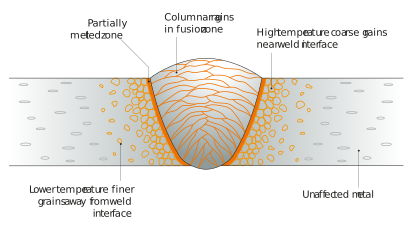
Figure: Zones in a weld and the resultant grain structures
We can see that the heat-affected zone is not uniform. This is due to the temperature variation experienced in the zone. Depending on the amount of energy added, the heat of the weld will be different. The type of base metal, its thickness and its ability to dissipate the heat into the surrounding base metal will all have an influence.
What happens in each zone?
In the fusion zone, the metals are completely melted, including the filler metal. If the filler metal has a different composition, this can cause a difference between the fusion zone and the base metal – with the potential to result in a galvanic interaction. Upon solidification, grains can also form of different compositions. The melted metal can react with oxygen if shielding is not sufficient.
There is also a thin unmixed zone where the base metal has melted but not mixed with the filler material.
In the higher-temperature part of the heat-affected zone, also known as the partially melted zone, there are changes to the grain structures. Sensitisation occurs as chromium carbide forms on the boundaries, which lowers the concentration of chromium inside the grains.
In the subsequent areas of the heat-affected zone, this effect becomes less prominent.
The best methods to prevent the negative effects of the heat-affected zone is to ensure proper shielding and manage the heat in the area.
There is also a thin, unmixed zone where the base metal has melted but not mixed with the filler material.