
Lesson 2 - Classification and Properties
In this lesson we will discuss what materials of construction are and why a better understanding of them is important to us. We examine the general classification of materials and highlight some of the most important ones in each relevant class. We will review the properties of materials and go into greater detail on these where required. To conclude, we focus on three things that can impact materials greatly: corrosion, degradation and welding.
Forms of Localised Corrosion
Localised corrosion is particularly problematic as it is often difficult to detect before failure occurs. Let us look at the most important forms of localised corrosion, beginning with pitting corrosion.
Pitting corrosion
Pitting corrosion is a localised corrosion that leads to the creation of small holes or perforations in a metal. It occurs in passivated metals where a small area is depassivated. The small area then acts as the anode, and the rest of the passivated surface acts as the cathode, causing localised galvanic corrosion. In stainless steel, this is normally caused by halide ions, such as chlorides. This can be made worse by stagnant conditions and high temperatures. The figure below shows an example of pitting corrosion.
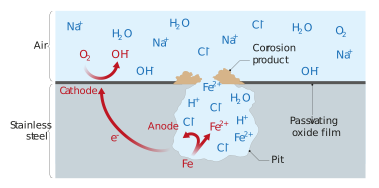
Figure: Pitting corrosion in stainless steel
A measure of a material’s pitting resistance is known as the Pitting Resistance Equivalent (PRE). In stainless steel, this is dependent on its composition. Another form of corrosion that is very similar in action to pitting corrosion is crevice corrosion.
Crevice corrosion
Crevice corrosion is the corrosion that happens in a small confined space, such as a join between materials, under a gasket, in a sharp corner where dirt builds up or under an incomplete weld. Corrosive substances tend to build-up in these areas. It is very similar to pitting corrosion but usually is less severe. The passivity in the crevice cannot easily repair itself due to the lower concentration of oxygen in the crevice. The figure below illustrates the mechanism of crevice corrosion.
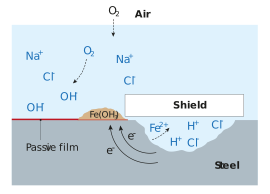
Figure: Crevice corrosion mechanism
Intergranular corrosion
Intergranular corrosion is where the boundaries of grains in the material are more susceptible to corrosion than the rest of the material. In stainless steel, the weld bead can reach 1450 °C. A short distance from the weld there is an area of weld-decay that occurs when temperatures reach between 425-870 °C. Precipitation of chromium carbide occurs in this region, which depletes the chromium. These boundaries are then preferentially dissolved, and this is known as sensitisation. Intergranular corrosion occurs in this section of weld-decay. The figure below illustrates this effect:
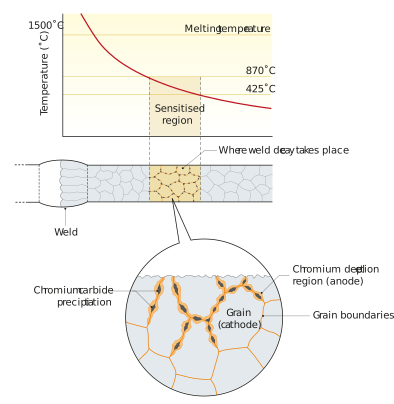
Figure: Mechanism of intergranular corrosion
Adding titanium or niobium to the mix, ensures that chromium is still available to form the passive film, since they will bind preferentially to the carbon forming carbides.
Microbiologically induced corrosion
Microbiologically induced corrosion (MIC) occurs as a result of aerobic and anaerobic bacteria. These often work together; the aerobic bacteria can create a slime build-up, allowing it to operate in the area below it. The metabolic by-products of these bacteria can attack passive stainless steel layers, and the slime build-up prevents oxygen from reforming the passive layer. In breweries, pasteurisers and effluent lines can be susceptible to MIC.
Stress corrosion cracking
Our final consideration on the list is stress corrosion cracking (SCC). You will recall from earlier in this lesson, stress refers to the force applied to a material. In this case, the stress has to be tensile stress, as SCC only occurs under tensile stress and not compressive stress. In addition to tensile stress, SCC requires a susceptible metal and corrosive conditions. Stainless steels are particularly susceptible because they have a passive layer. Corrosive conditions for stainless steels include halide ions typically in the form of chlorides and temperatures above 60 °C. For other metals, other conditions will be required, but the mechanism is the same.
Stress corrosion cracking normally starts as another form of corrosion, such as pitting corrosion or intergranular corrosion. The tensile stress that the material is under causes cracking at the weakened point of pitting, or other corrosion; as the cracks appear, more unpassivated metal is exposed to corrosion. These cracks can be transgranular or intergranular. The photograph below shows how cracks can propagate.
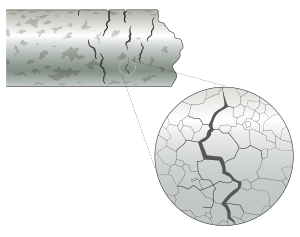
Figure: Photograph of stress corrosion cracking
Erosion, cavitation and impingement
Some forms of corrosion are physical. Erosion is the slow wearing away of a material, which is a result of the friction forces of a media against it. At high velocities, a liquid can cause more severe erosion; this is known as impingement. Cavitation can also cause similar effects. This is when gas bubbles form in a liquid as a result of two different pressure conditions. These bubbles can implode, and the forces associated with this cause accelerated erosion. These conditions of impingement and cavitation are often the start of pitting corrosion as they cause a weakness in passivated layers.
Now that we have covered corrosion of metals, we can explore the degradation of polymers.