
Lesson 2 - Classification and Properties
In this lesson we will discuss what materials of construction are and why a better understanding of them is important to us. We examine the general classification of materials and highlight some of the most important ones in each relevant class. We will review the properties of materials and go into greater detail on these where required. To conclude, we focus on three things that can impact materials greatly: corrosion, degradation and welding.
Corrosion
Corrosion has a huge impact on the functionality of a metal. These impacts range from aesthetic to mechanical and can lead to the near-total destruction of a metal.
The World Corrosion Organisation estimates that $2.5 trillion is spent on the effects of corrosion every year. This is 3-4% of the world GDP.
Corrosion is the breakdown of a material due to chemical and electrochemical reactions between the metal and its environment.
In theory, this definition could apply to all materials; however, the term ‘corrosion’ is normally reserved for metals. When we deal with other materials, the term ‘degradation’ is more commonly used.
So why do metals corrode? A simple explanation is that they are trying to go back to their base state. With the exception of the noble metals (gold, silver, rhodium, palladium, platinum), all metals are found in ores where they are chemically bonded to substances such as oxides. Once extracted, these metals are in an unstable state, and tend to react to form more chemically stable compounds. Thus, noble metals have been sought after, as they retain their pure metal structures under most conditions.
Corrosion can be generalised or localised. If it is generalised, the entire surface will corrode uniformly, and it is easy to measure the rate at which it is occurring. With local corrosion, only a small section corrodes, and this often goes undetected until failure occurs.
In order to understand corrosion better let us look at some common types of corrosion, namely galvanic and localised forms.
Galvanic corrosion
Galvanic corrosion occurs when two different metals are in contact with each other in the presence of an electrolyte. Every metal has an anodic potential; this is indicative of the potential of the metal to be an anode (an anode is an electron donor). The metals with the lowest anodic potential act as the cathodes (a cathode is an electron receiver) and are electron recipients. The metals with the highest anodic potential act as the anodes and are electron donors. The more anodic material of the two undergoes corrosion. The figure below shows the range of anodic potential for a few metals:
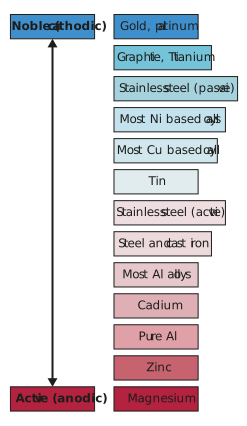
Figure: Galvanic potential for common metals
Looking at the figure below, we can see how this works in practice. Electrons flow from the iron (Fe) to the copper (Cu). The copper cathode releases electrons and hydrogen forms. The iron anode is corroded as Fe2+ ions are formed. These react with oxygen to form oxides. Thus, the iron being the anode sacrifices its electrons to the copper as the cathode.
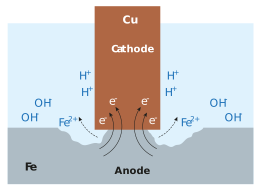
Figure: Galvanic corrosion between iron and copper
How can corrosion be prevented? The figure below gives a few examples:
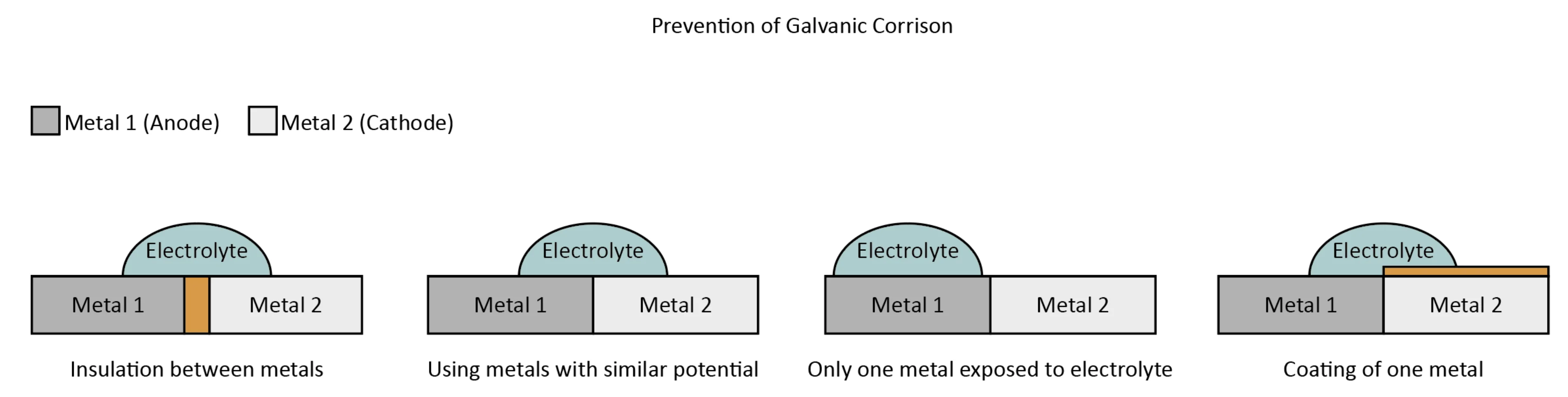
Figure: How to prevent galvanic corrosion
Another driving force in galvanic corrosion is the relative areas of the two metals. If you have a big cathode and a small anode, the anode will corrode much faster than if you have a large anode and a small cathode. This is especially important to consider when using fasteners of a different material to that of the bulk material.
One of the main methods used to prevent corrosion is the passivation of a metal. Passivation is the formation of an inert layer on the surface of a metal as a result of the metal’s reaction with oxygen and other molecules. We will learn more about passivation in the Materials Application in Brewing lesson later in this unit.
Galvanic corrosion can even happen when you bake a potato. If you cover a steel baking tray with aluminium foil, there is the potential for the liquid in the dish to act as an electrolyte causing the aluminium to corrode.
Now that we have an understanding of galvanic corrosion, let us have a look at some other forms of corrosion.