
Lesson 2 - Classification and Properties
In this lesson we will discuss what materials of construction are and why a better understanding of them is important to us. We examine the general classification of materials and highlight some of the most important ones in each relevant class. We will review the properties of materials and go into greater detail on these where required. To conclude, we focus on three things that can impact materials greatly: corrosion, degradation and welding.
Properties of Materials
It would be helpful to have an understanding of general properties that materials can have, before going into more detail on specific materials. When selecting a material for a specific application, it is important to know that the material can perform the job required of it.
The most important properties are listed in the table below:
Table: Properties of materials
|
Property |
Example Descriptors |
|
Mechanical |
stiffness, strength, ductility, brittleness, hardness, toughness |
|
Physical |
density, electrical and thermal conductivity, porosity, permeability, texture (roughness) |
|
Chemical |
corrosion resistance in various environments, toxicity, inertness |
|
Manufacturing |
weldability, formability, machinability, ease of joining |
|
Economic |
price, expected lifespan, maintenance requirements, recycling possibilities |
Most of these properties are self-explanatory but let us take a closer look at mechanical properties.
Mechanical properties
Mechanical properties refer to how a material responds under stress. The figure below indicates the four main types of stress.
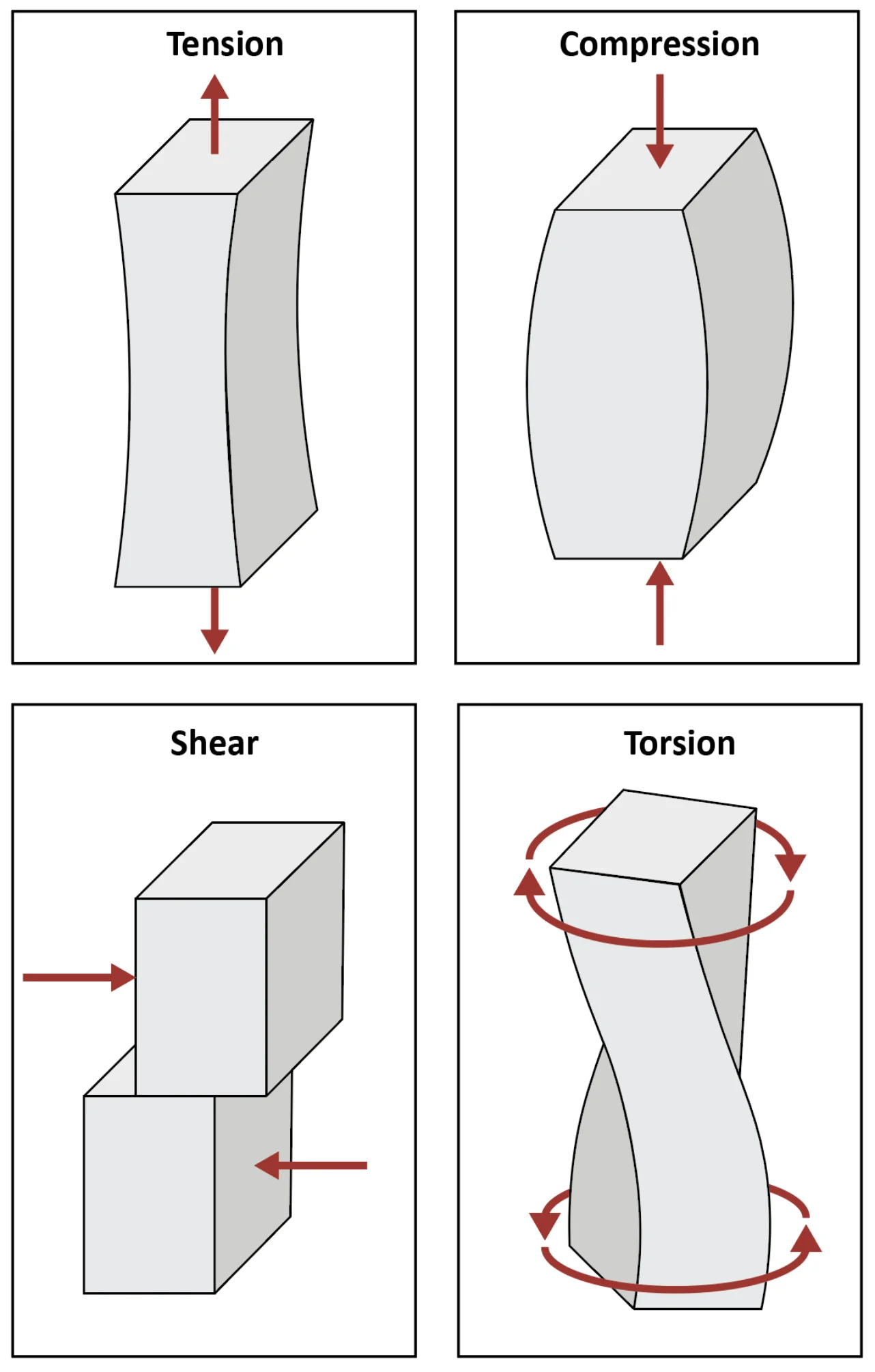
Figure: Types of stress on a material
The stresses on a material result in strain, which is a measure of the change in the material as a result of the stress. The figure below shows a typical stress-strain graph for a metal and can be used to explain several mechanical properties. The y-axis indicates the stress on a material and the x-axis indicates the deformation in the material measured as the change in the length of the material over the original length.
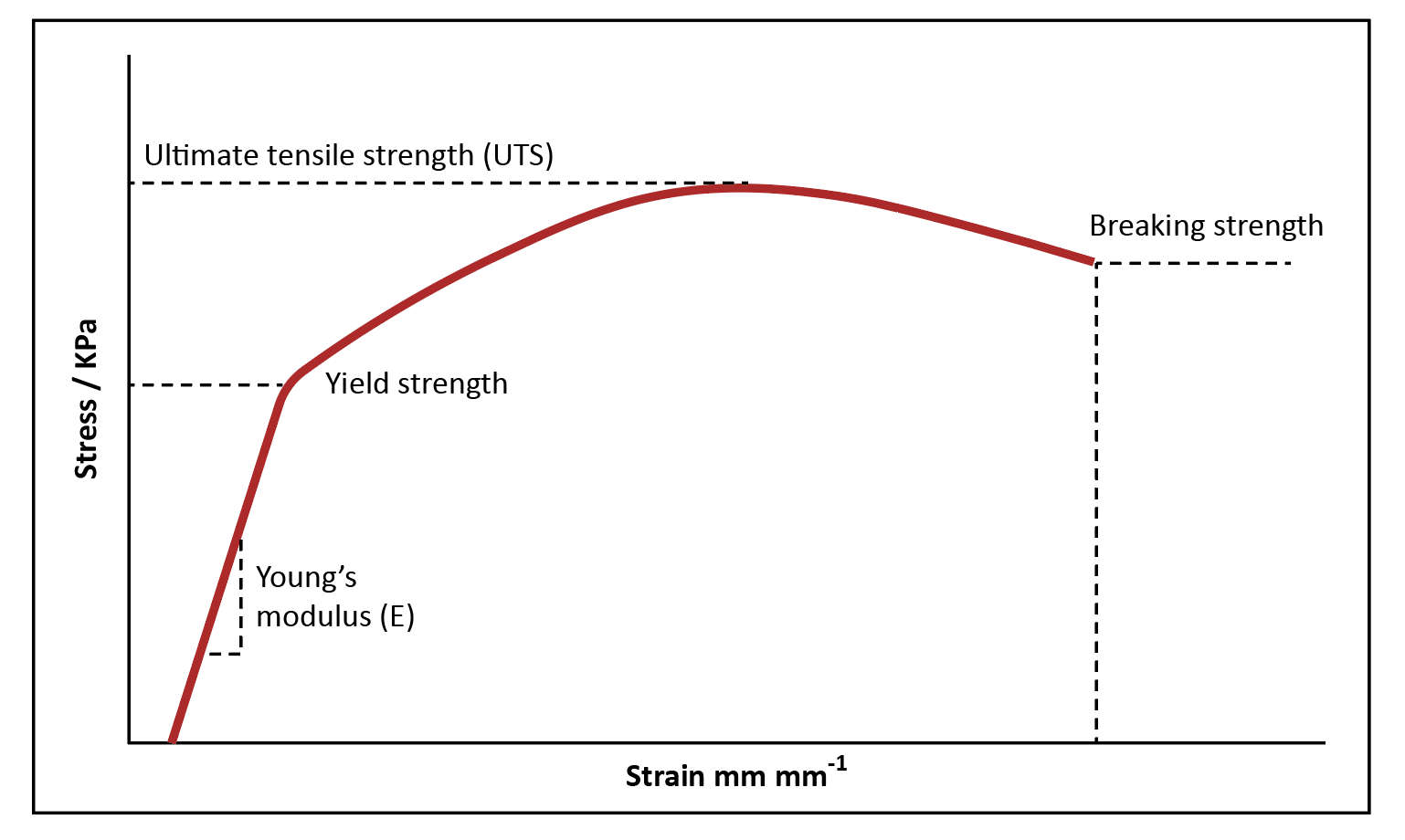
Figure: A typical strain test performed on a metal
The table below summarises some key terms associated with the mechanical properties of materials.
Table: Explanations of mechanical properties of materials
|
Property |
Meaning |
|
Stiffness |
The ability to withstand a force without deforming. If a material is very stiff, there will be a slight change in its length for a comparatively large stress placed on it. |
|
Young’s Modulus |
The ratio of stress to strain in the elastic region, which is shown by the gradient of the line. If the gradient is steep, the material is very stiff, and if it is flat, then the material is very elastic. |
|
Elasticity |
How well a material under stress returns to its original form after the stress is removed; when the stress exceeds the elastic limit, the material is permanently deformed. |
|
Yield/proof strength |
The amount of stress needed to produce permanent deformation. Beyond this point, the material cannot return to its original dimensions. |
|
Ultimate tensile strength (UTS) |
The maximum strength of stress a material can withstand before it fractures. |
|
Ductility |
The amount of plastic deformation a material can withstand before breaking. |
|
Brittleness |
Breaking, without first developing cracks or deformation in response to stress. |
|
Hardness |
The ability to not be damaged by scratching, abrasion, indentation or abrasion; its wear and tear resistance. |
|
Toughness |
Resistance to impact. |
|
Creep |
The slow deformation of a material under low stress. This can happen with metals at higher temperatures and polymers at lower temperatures. |
We shall now explore some of the above terms using an example. Think about a balloon: if you blow it up a little bit, it can return to its original form. How much you can inflate it without it permanently changing shape is a function of its elasticity. Once it reaches a point of no longer returning to its original shape, it has reached its yield strength, and from this point on undergoes plastic deformation. Once it breaks, it has reached its breakpoint, otherwise known as its ductility. It is a bit confusing that plasticity is a property that applies to metals as well.
Another property that is important to understand a bit more about is the roughness of a surface. Surface roughness, Ra, is defined as the average of the surface profile of a material. A profilometer can be used to measure the surface profile. These can be of the contact variety (typically a diamond stylus) or optical.
Now that we have reviewed the material properties, we will take a closer look at the two biggest influences on materials: the corrosion of metals and the degradation of polymers.