
Lesson 2 - Classification and Properties
In this lesson we will discuss what materials of construction are and why a better understanding of them is important to us. We examine the general classification of materials and highlight some of the most important ones in each relevant class. We will review the properties of materials and go into greater detail on these where required. To conclude, we focus on three things that can impact materials greatly: corrosion, degradation and welding.
General Classification of Materials
In this section we will describe one of the most accepted ways of classifying materials.
The figure below shows a typical classification tree.
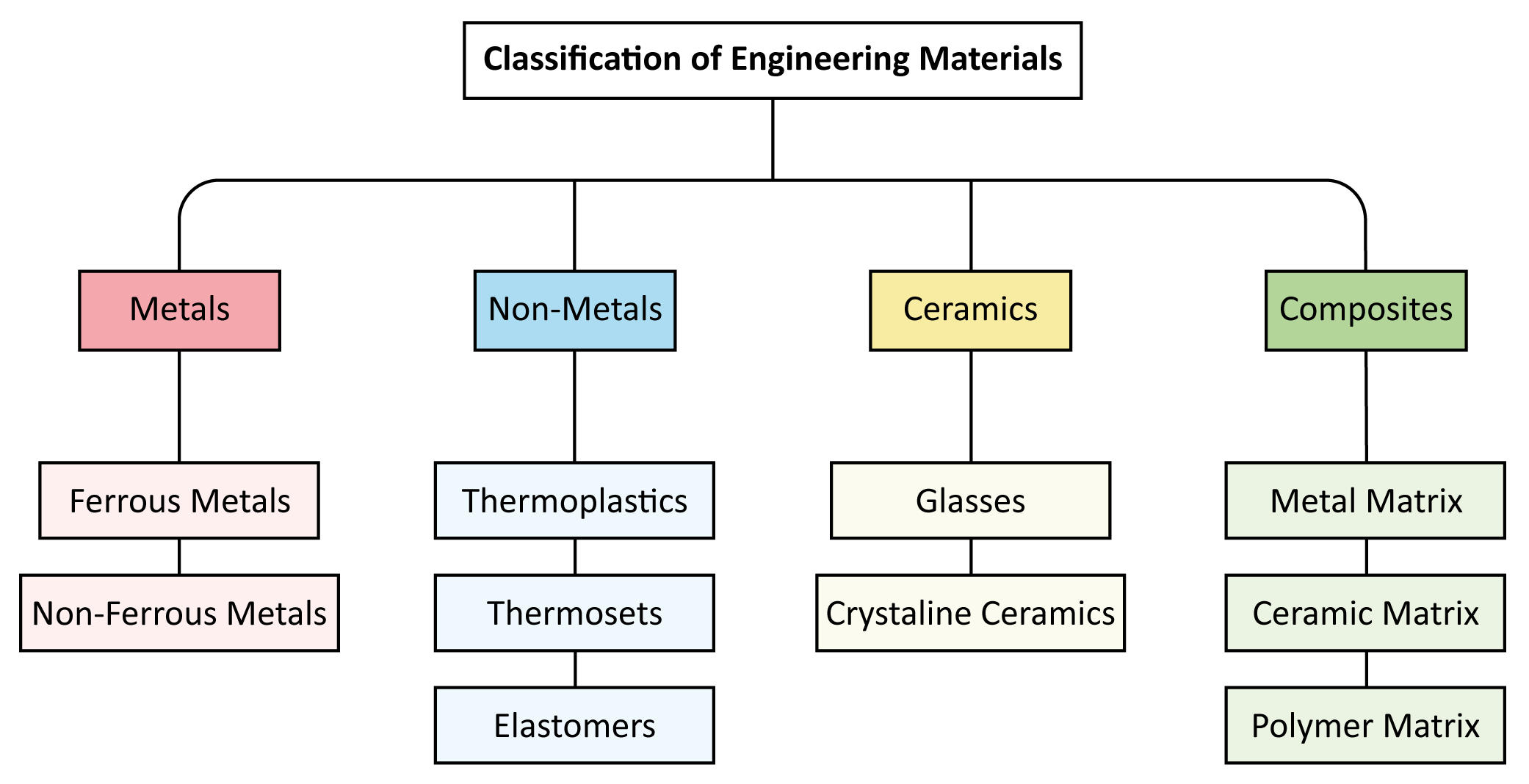
Figure: Classification of materials
As we can see from the image above, this classification covers a wide range of materials.
Let us briefly look at each of these classifications.
Metals
Metals are characterised by a crystal lattice structure of positive metallic ions which commonly share their outer electrons. If you look at the figure below, all the electrons are shared throughout the lattice. This is what makes metals capable of being bent without breaking.
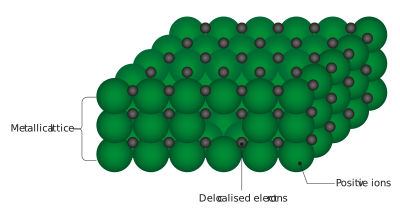
Figure: Metal lattice structure
Metals are classified as either pure metals, which contain only one element; or alloys, which contain a combination of elements. For example the pure metals copper and zinc are combined to make the alloy brass. They can further be divided into ferrous metals and non-ferrous metals.
- Ferrous metals – These metals are rich in iron. Some examples are cast iron, carbon steels, alloy steels and stainless steels. In a brewery, carbon steels are used mainly in building structures and equipment support. Stainless steels are widely used for equipment.
-
Non-ferrous metals – These metals have no or little iron. A few examples are copper, bronze, aluminium, titanium, and gold as well as alloys of these metals. Copper used to be the metal of choice for brewing equipment but has largely been replaced by stainless steel.
Polymers
Polymers are formed by combining a large number of monomer molecules to form more complex, or long-chain, molecules. The main building block of polymer materials is carbon, which is combined with other elements such as oxygen, hydrogen, nitrogen or chlorine. One of the most common polymer groups is called plastics.
Plastic is defined as ‘capable of being moulded or modelled’. It includes the non-metallic, mouldable compounds, as well as the articles made from them. The term plastics is more of a generic term than a scientific one. Rubber and glass are also easily formed into any shape during processing, and they retain that shape after cooling. The word plastics now generally applies to the synthetic products of chemistry, and not the natural products. These chemical products are processed into an enormous variety of shapes.
Let us consider the three main classes of polymers:
- Thermoplastics – Thermoplastic materials can be softened and re-hardened indefinitely. Typical examples include polyvinylchloride, polytetrafluoroethylene (PTFE), nylon, polyethylene and polycarbonate. You may recognise PTFE as the Teflon coating on your frying pan. It is often used as gasket material in brewing, especially in high temperature applications. High density polyethylene is used extensively for water storage tanks and pipes.
-
Thermosets – These materials are rigid. They cannot be softened by the application of heat. Examples of thermosetting polymers are phenolics, epoxies and resins. A common example of thermosets in the brewery is epoxy flooring.
-
Elastomers – These polymers allow considerable elastic behaviour. They include rubber, silicone, and polyurethane. In the brewery, they are typically used for gaskets and hoses.
Ceramics
Ceramics are inorganic compounds consisting of a metal, or in some cases a semi-metal, and one or more non-metal. They are divided into two categories:
- Crystalline ceramics – Crystalline ceramic materials cover a wide range of ceramics. They include everything from bricks to cement to high-end ceramic filters and coatings.
-
Non-crystalline ceramics – This is another term for glass. Glass is formed by melting, moulding and blowing. If glass is heat treated after being formed, it becomes partly crystalline and is then called a glass-ceramic.
Crystal glass does not have a crystalline structure. It contains lead which differentiates it from glass.
To learn how to tell the difference have a look at the following: https://treasurepursuits.com/how-to-tell-glass-from-crystal/.
Composites
A composite material is a mixture of at least two separate phases that are mixed or bonded together. Composites have superior mechanical properties compared to their constituents. Composites are generally classified according to their main component, known as the matrix material, referred to also as the main phase. Composite materials can be classified as:
-
Metal matrix composites, such as tungsten carbide cutting tools and disc brakes
-
Polymer matrix composites, such as fibreglass
-
Ceramic matrix composites, such as concrete
Other common examples include aluminium reinforced with silicon carbide or carbon fibres, nylon reinforced with glass fibres, and ceramic materials reinforced with fibres of silicon carbide.
Other
What materials can you think of that we have not covered so far? One that comes to mind is wood. Wood is not commonly used in the brewing and distilling industry other than for casks.