
Lesson 5 - Effluent Treatment SAQ
This lesson allows you to test yourself on the material covered in the Effluent Treatment lesson and determine the level to which you have met the learning outcomes.
Suggested Response - Q2
* a) Explain the differences between primary, secondary, and tertiary effluent treatment.
b) What is the aim of primary effluent treatment and why is it important?
c) Describe the operation of a DAF unit.
Response:
a) Primary treatment (pre-treatment) is used to either prepare the effluent for further treatment or to treat it sufficiently to meet the minimum discharge requirements.
Secondary treatment (main treatment) focuses on reducing the total biological and chemical load in the effluent to meet more stringent discharge requirements.
Tertiary treatment (polishing treatment) focuses on treating the effluent to allow for reuse in the process.
b) Primary effluent treatment focuses on removing solids from the effluent, as these can be harmful to effluent treatment processes and can clog up the equipment. It also balances the effluent to ensure that it is more uniform in composition and flowrate. This makes it easier for the downstream equipment as it does not have to deal with large fluctuations. Finally, it ensures the pH is at the right level for further treatment, as biological processes rely on a certain pH to function optimally.
c)
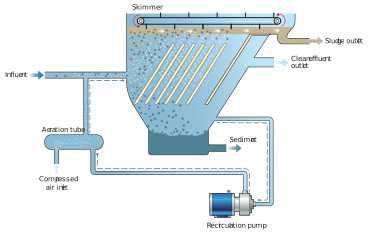
Figure: DAF unit
The effluent feed to the DAF system is mixed with a stream of recycled aerated water. Solids attach to small bubbles that push them to the surface. Heavier particles settle out and a set of plates help with the separation. This allows for floating solids to be removed from the top and settled solids from the bottom. These steps are illustrated in the figure above.