
Lesson 6 - Radiation and Combined
This lesson deals with the principles and application of a form of heat transfer called radiation. This lesson will also combine the heat transfer methods you learned previously to provide an overall picture of heat transfer processes in a brewery.
Thick versus Thin Wall Pipes
Before we combine all forms of heat transfer, one last distinction should be made about the surface area of heat transfer in pipes.
The area used in a heat transfer calculation should be the area that the heat transfer is taking place. In a thin walled pipe, the difference in area of the inside of the pipe to the outside of the pipe is rather close. However, in a thick walled pipe, such as a pipe with insulation, the surface area of heat transfer will change from the centre of the pipe to the outside. For this reason, in thick walled pipes the area used is the log mean area of the pipe, defined as:

Where L is the length of the pipe and the inner and outer radii of the pipe are r1 and r2 respectively.
Let us do an example involving a thick wall pipe.
Steam at 170°C flows through a 100 m length insulated pipe. The pipe ID is 150 mm and the pipe thickness is 7.5 mm. The insulation is 50 mm thick with a thermal conductivity of 0.073 Wm-1 K-1. The surface temperature of the insulation is 37°C.
Calculate the rate of conduction through the insulation.
To solve this problem, we will first draw a schematic to better illustrate the scenario.
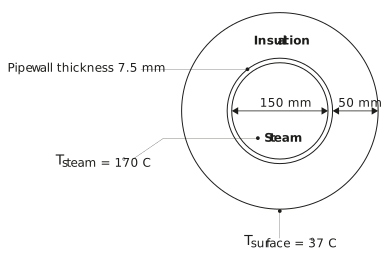
Figure: Conduction through insulated steam pipe
We will use the overall heat transfer equation to solve for the rate of heat transfer via conduction.

The thermal resistance of both the inside condensing film coefficient of steam and the wall of the pipe will be negligible compared to the insulation so we can ignore those terms in the determination of U. So, we can simplify to:

The area of heat transfer will be the log mean surface area of the pipe.
The length of the pipe is given as 100 m.
r1 is the distance from the inside of the steam pipe to the outside of the steam pipe.

r2 is the distance from the inside of the steam pipe to the outside of the insulation.

Now we need to calculate the area.


Finally, we can calculate the conductive heat transfer rate.


