
Lesson 6 - Radiation and Combined
This lesson deals with the principles and application of a form of heat transfer called radiation. This lesson will also combine the heat transfer methods you learned previously to provide an overall picture of heat transfer processes in a brewery.
Combined Heat Transfer: Convection and Conduction
In real-world applications, convection and conduction are almost always found working in unison. Recall that convection heat transfer occurs when heat transfers through fluids like a gas or liquid. Conduction occurs when heat travels within a solid surface. Examples that involve both forms of heat transfer occur in many places in a brewery. For example, for a fluid in a pipe surrounded by insulation, convection occurs in the fluid and conduction occurs between the pipe material and the insulation.
Let’s consider a multi-layer system. Consider two fluids separated by a wall. A hot fluid is in direct contact with one side of the wall. A cold fluid is in direct contact with the other side of the wall. Heat is transferred from the hot fluid, through the wall, and to the cold fluid. This is illustrated in the figure below.
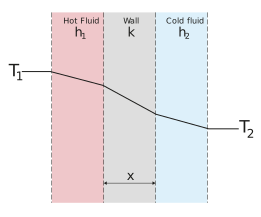
Figure: Heat transfer through a wall
The hot fluid far from the wall is at temperature T1. In the liquid, convection is occurring and results in a slightly lower temperature at the wall. Through the solid wall, the heat transfer occurs by conduction. We know this because heat is travelling through a solid and not through a liquid. On the other side of the wall, heat transfer through the fluid again happens via convection until we reach a final temperature, T2.
Heat transfer by conduction through the wall is characterised by the term k/Δx, which has the same units as a heat transfer coefficient. Note that Δx refers to the wall thickness or difference in X1 to X2.
For convective heat transfer, we have the film heat transfer coefficient, h.
If we look at this scenario in the bigger picture, we essentially have three different coefficients involved in the multi-layer heat transfer example above – one for each fluid and one for the solid. We have a film heat transfer coefficient for both the hot and cold fluids, and the conductive heat transfer coefficient of the wall.
An overall heat transfer coefficient, U, is used to add these factors together, which can be used to calculate an overall heat transfer rate of all forms of heat transfer within a multi-layer system. The equation used to calculate the heat transfer through a multi-layer system is:

Where
q is the heat transfer rate in W
U is the overall heat transfer coefficient in Wm-2 K-1
A is the heat transfer area in m2
∆T is the temperature difference across the entire wall T1 − T2 in K
Overall heat transfer coefficient
To develop the overall heat transfer coefficient, we can write an equation for the heat transfer through each portion of the system.
For convection through the hot fluid, we have:

For conduction through the wall, we have:

For convection through the hot fluid, we have:

Here, each ∆T is the temperature difference across each layer. We can then write an equation for ∆T across the entire wall as:

We will show how the heat transfer rate across the entire wall can be calculated as the ratio of the overall temperature drop ∆T to the overall resistance of the wall. We show this derivation so that we can conclude with an expression for an overall heat transfer coefficient.
Solving the previous heat transfer rates for ∆T gives us:

Entering these expressions into the overall ∆T:

Since, in steady heat flow, all of the heat that passes through the first layer of resistance must pass through all of the layers, the rates q1, q2, and q3 are all equal to the overall q. Similarly the areas for each type of heat transfer are equal to each other, in this example (i.e. A1 =A2 =A3 =A). Therefore, we can rewrite and solve for q like so:

Here we introduce R1, R2, R3 as the terms for “heat transfer resistance “ for each layer, calculated as the reciprocal of individual layer heat transfer. Also R as the overall heat transfer resistance, being the sum of individual layer resistances. Equating this summation with the previously presented equation used to calculate the heat transfer through a multi-layer system gives us:

Hence the overall heat transfer coefficient is equal to the reciprocal of the overall resistance:

To determine the overall heat transfer coefficient for our system, we will use the reciprocal sums technique described above. This technique is described below for the system we described above.

Where
U is the overall heat transfer coefficient in Wm-2 K-1
h1 is the film transfer coefficient of fluid 1 in Wm-2 K-1
x is the thickness of the wall in m
k is the thermal conductivity of the wall material Wm-1 K-1
h2 is the film transfer coefficient of fluid 2 in Wm-2 K-1
For each layer in the system, there will be an additional resistance factor.
Let’s do an example calculating the heat transfer rate associated with the system described above. Let’s assume the hot fluid is wort at 90°C with a film heat transfer coefficient of 1,000 Wm-2 K-1. The cold fluid is water at 14°C with a film heat transfer coefficient of 1,250 Wm-2 K-1. The wall is 2 m wide by 2 m long and 1 cm thick. The wall is made of stainless steel. Stainless steel has a thermal conductivity of around 20 Wm-1 K-1.
First, we need to calculate the overall heat transfer coefficient.
From the problem statement we have the film heat transfer coefficient for fluid 1 and fluid 2. We also are given the thermal conductivity of the wall as well as the thickness of the wall. We can then enter the values and solve for U.


Now we have calculated the overall heat transfer coefficient, we can use it in the overall heat transfer equation.
The area of the wall is 2 m by 2 m = 4 m. The temperature difference is 14°C – 90°C = -76°C. Although we have defined ΔT in Kelvin, as any temperature in centigrade is the temperature in Kelvin minus 273, ΔT has the same value in both units. We therefore don’t need to convert centigrade into Kelvin for this calculation. We now have all the values and can calculate.

Now we can develop an overall heat transfer coefficient for a multi-layer system. This concept is important for heat and cooling processes in a brewery, such as for heat exchanger design. You will learn more about this in the next lessons in this unit.
These calculations have limited accuracy; in fact they are subject to a large margin of error, up to +/- 30%, because it is often notoriously difficult to estimate some film heat transfer coefficients accurately. For instances where surfaces are clean and new, there lies a true heat transfer coefficient. However, as surfaces become increasingly dirty there is one last resistance factor we need to account for.