
Lesson 6 - Radiation and Combined
This lesson deals with the principles and application of a form of heat transfer called radiation. This lesson will also combine the heat transfer methods you learned previously to provide an overall picture of heat transfer processes in a brewery.
Radiation
Radiation is a form of energy transfer that occurs through space by electromagnetic waves. These waves occur at different wavelengths and can be radio, micro, infrared, visible light, ultraviolet, x-, or gamma rays.
When radiation waves pass through empty space, they do not transform to heat or change direction. However, when they hit matter, the radiation is transmitted, reflected, or absorbed. This is illustrated in the figure below.
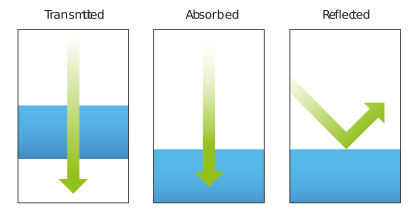
Figure: Radiation waves in contact with a body of matter
When radiation waves, also referred to as energy waves, transmit through a surface, the energy passes through the surface. When the energy is reflected, the energy reflects away from the surface, changing the original course of the waves. When the energy is absorbed, it is retained by the surface as heat.
Radiation waves can also act in a combination of reflection, absorption, and transmission. They may also be refracted, meaning they bounce off at various angles.
When radiation waves come in contact with the surface of a body of matter, the radiation that is absorbed is stored as heat.
When energy waves hit a surface, what happens to the energy is entirely dependent on the properties of the surface. A surface may be a good transmitter, a good reflector, or a good absorber. For example, a window transmits nearly all the radiation that hits it. Windows made of clear glass allow virtually all radiation waves which strike them to pass through. A mirror reflects nearly all the radiation that hits it. Lastly, a black surface absorbs nearly all the radiation it receives and transforms the absorbed energy into heat. For instance, if you step onto a black pavement with bare feet in summertime your feet will get hot, because the black pavement absorbs the incoming sun rays of the energy as heat.
Next, we will discuss how radiation energy is quantified using yet another law – the Stefan-Boltzmann law.