Lesson 6 - End of Unit SAQ
This lesson provides the opportunity for you to test yourself on the material covered in all of the lessons in the Gases Unit.
Suggested Response - Q3
***
a) You want to carbonate a tank of water open to the atmosphere using either a lance or sintered stone at the base of the tank to dissolve CO2. With reference to the equation below, which describes the rate of dissolution of CO2, compare and contrast the performance of both technology options.

b) If the tank could be operated with a back-pressure, what would be the impact on the performance of either technology?
Response:
a)
First, let’s start by describing what a lance and a sintered stone are:
-
Lance – an open-ended piece of pipe, which sometimes has a reducing diameter at its end, which is placed within a vessel for in-vessel batch dissolution. Gas is introduced through the lance and a bubble stream is produced at the end of the lance.
-
Sintered stone – a partially fused porous material typically made from metal or ceramic powder. The partial fusing process results in many small holes which produce a stream of fine bubbles.
Next let’s consider the gas transfer equation and identify the relevant terms we will use in comparing the gas transfer performance of the lance and the sintered stone:
-
kL – gas transfer coefficient
The gas transfer coefficient principally relates to the intensity of contact between the gas and liquid phases. It is not possible to compare the two carbonation devices, as we know little on the relative intensities of contact.
-
A – interfacial area
As the sintered stone produces a stream of smaller bubbles, the interfacial area will be larger than for a lance.
-
Volume V – no difference between the devices, as we can assume the volume of the tank contents will be the same
-
CE – equilibrium concentration of CO2
If the same headspace pressure were chosen for both devices, there would be no difference in CE.
-
dCt/dt – rate of gas transfer
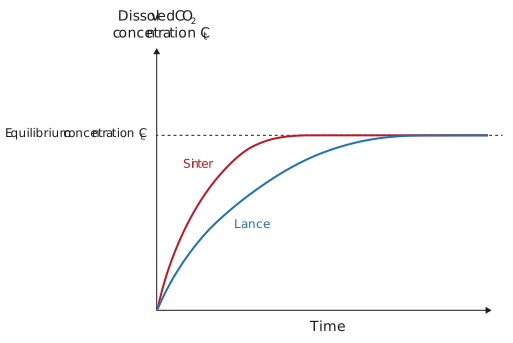
The rate of gas transfer is likely to be higher using the sintered stone, principally due to the increase in A. (Note the commentary about the difficulty in comparing kL.)
We would expect to see comparative plots of dissolved CO2 concentration against time to be as shown below, with the tank reaching equilibrium in a shorter time.
Other factors to consider are:
-
The sintered stone would be more difficult to clean due to its many pores. This may require removal of the sinter and manual cleaning.
-
The sintered stone would have a higher capital cost, as the lance could be essentially a piece of pipe.
b)
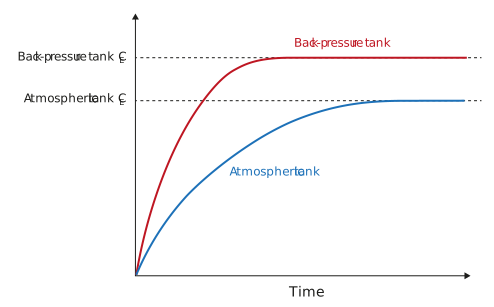
Operating the tank against a back-pressure through the throttling action of a pressure-control valve on the vent line of the tank would exert a CO2 pressure greater than atmospheric on the tank and its contents.
Consider Henry’s law (p = Hx), where p is the partial pressure of the gas above the liquid. In the case of pure CO2, the partial pressure of the CO2 would be the back-pressure on the tank. Hence, as the back-pressure increases, the equilibrium concentration would increase (CE in the gas transfer equation below).
As CE increases, the term within the brackets also increases, and it increases the rate of gas transfer dCt/dt, as shown in the figure below.