
Lesson 1 - Introduction to Gases
This lesson introduces the Gases unit. It also contains a brief overview of the topics that you will study in the forthcoming unit.
Topics Covered in this Unit
This unit deals specifically with a group of fluids called gases. We are surrounded by them, we breathe them, and when dissolved in beer… we drink them! In this unit, we explore their behaviour under conditions of specific pressures and temperatures, and consider how these factors influence their dissolution in liquids.
In this unit you will explore:
-
The four most common gases in a brewery: air, carbon dioxide, oxygen, and nitrogen; you will also investigate their uses.
-
The mole (not the furry animal!), which is an alternative way to measure the quantity of gas, using its volume, rather than its mass in kilograms. This alternative measure allows us to more effectively compare quantities of gases regardless of what type of gas we are dealing with.
-
The gas ‘laws’ of Boyle, Charles, and Gay-Lussac, in addition to a combined form of these laws, known as the universal gas law (as shown below):

Interestingly, the name Gay-Lussac may be familiar to you. He was very influential in many aspects of brewing. He co-discovered the composition of water (the H2O bit!). He additionally studied the properties of alcohol-water systems; there is in fact a unit named ‘degrees Gay-Lussac’. He also defined the overall chemical equation for fermentation. He is thus not just a definer of gas laws!
-
How mixtures of gases can be considered to exist on their own. We can describe this using the explanation of partial pressures, e.g. a single gas would exert its own partial pressure if it alone occupied the volume of a mixture. John Dalton considered the concept of partial pressures further by defining his own law (see below).
-
Why processes such as beer carbonation are important for transferring gases into and out of solution. We will apply Dalton’s law together with Henry’s law to define equilibrium saturation conditions for liquids as a function of pressure. This will include partial pressures as appropriate for mixtures, and temperature. The figure below shows the gas transfer behaviour of CO2 when dissolving in a liquid:
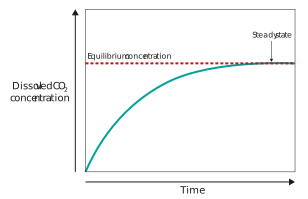
Figure: Plot of dissolved CO2 concentration against time
-
Practical, everyday ways to define gas solubility using data tables.
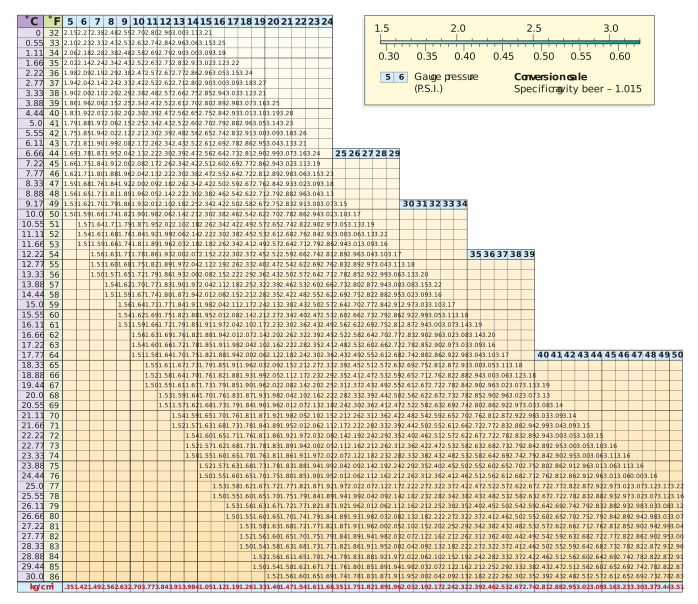
Figure: The solubility of carbon dioxide in beer
-
How we can express the dynamic behaviour (rate or speed) of gas transfer using the equation below. We will use this equation to assess the key factors that influence the speed at which we can transfer gas into solution.

-
Differing kinds of gas transfer technology, including the classic Venturi carbonator (as shown in the figure below):
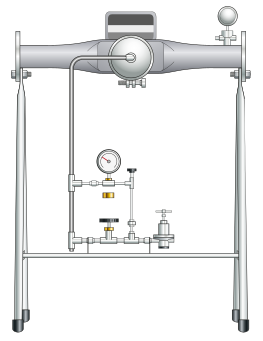
Figure: External view of a Witterman Venturi carbonator