
Lesson 5 - Beer Haze SAQ
This lesson enables you to test yourself on the material covered in the lesson on Beer Haze and to determine the level to which you have met the learning outcomes.
Suggested Response - Q3
** Discuss the formation of protein: tannin hazes in beer and the implications of an imbalance of the two components.
Response:
The interaction of proteins and polyphenols follows a progression from chill haze to permanent haze.
Initially, polyphenols, the simple flavonoids or proanthocyanidins (particularly the dimeric and trimeric forms of flavanols), associate loosely with the proline amino acids of proline-rich haze active polypeptides and proteins, forming a soluble colloid.
The proanthocyanidins grow through oxidation and polymerisation to tannins and stronger hydrogen bonds form, which result in an insoluble complex when cooled to 0 °C. These bonds are still weak, however, and can be broken by warming to 20 °C. This reversible haze is referred to as chill haze as it is only visible in chilled beer.
Further agglomeration of these colloids – through binding of the polyphenol and proline moieties – forms covalent bonds which are not broken by warming. This is classified as a permanent haze.
Chill hazes form in maturation when the beer is chilled to 0 °C or lower. The brewer can take advantage of these insoluble hazes to remove them by filtration. Added process aids can selectively bind protein or tannin, increasing the particle size.
Failure to maintain the cold conditions en route to the filter can result in the chill haze re-dissolving. This is bad news as the components will re-associate in package, resulting in a hazy beer.
The Siebert model describes the need for balanced concentrations of protein and tannin. If proteins are in excess, insufficient complexes will form due to lack of tannin binding sites. The same is true if tannins are in excess. This concept is best depicted in an illustration.
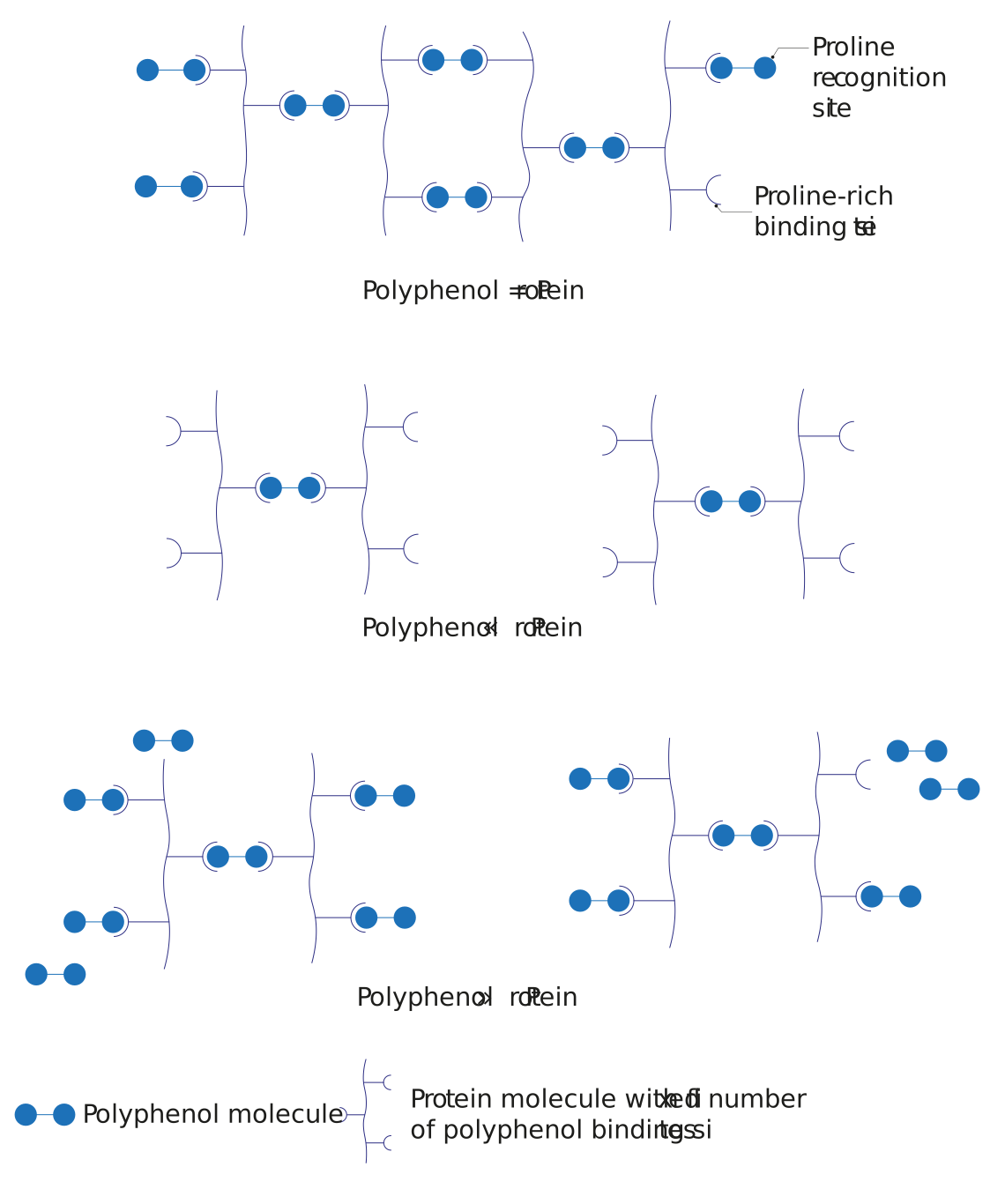
If the concentrations are not matched, there is an inability to form large insoluble complexes (e.g. haze particles). This allows the brewer to focus on the removal of either protein or polyphenol molecules through the use of chill-proofing process aids. Where a long colloidal shelf-life is needed, for example, in export beer, both protein and polyphenol reduction are targeted.