
Lesson 10 - Maturation and Finishing End of Unit SAQ
You have now completed the Maturation and Finishing Unit. This lesson enables you to test yourself on the material covered and to determine the level to which you have met the learning outcomes. It will provide you the opportunity to test your knowledge with a last set of self-assessment questions.
Suggested Response - Q5
***You have been asked to head up a workstream to scope future-proofing the brewery from brewhouse through to packaging. As sales figures are buoyant, the company is planning to invest heavily in the site and wants to make sustainable improvements that will deliver volume, efficiency and productivity improvements. You currently have horizontal maturation vessels and a horizontal leaf filter. What processes would you look to replace, and what benefits would you expect to see?
Response:
Future-proofing a business moves it towards a greener, more sustainable and cost-efficient way of working. In the brewing world, the large equipment manufacturers have bought into this and developed advancements in their technologies and indeed, novel new technologies. In the maturation area, a brewery evolves considerably from a classic horizontal tank and horizontal leaf filter set-up.
Modern designs of breweries now use uni-tanks, where fermentation and maturation can take place in the same vessel. This can be particularly beneficial for smaller breweries as it gives them far more flexibility than using dedicated vessels. Good brewing practices allow for further yeast crops during maturation to limit off-flavour development; based on all of these requirements, the uni-tank is a vertical cylindroconical vessel with cooling jackets positioned at the top and bottom of the vessel. Other than the flexibility advantage, there are several other advantages for combining fermentation and maturation in one tank. These include:
-
Improved product quality due to less microbiological and foam retention risks because of fewer transfers
-
Better opportunities to automate
-
Smaller tank footprint
-
Lower operating costs
-
Installation of dynamic mixing devices inside the vessel to improve homogeneity, rate of cooling, reduces CO2 toxicity and possible elimination of carbonation
To remain responsive in the brewing industry, a brewer needs to have the tools to be dynamic and create new beer styles as the market evolves. A separate ‘extraction vessel’ where beer is pumped out of the fermenter/maturation vessel, through the extraction vessel and back into the fermenter/maturation vessel is a neat solution for beer differentiation. The extraction vessel is typically charged with hops as a method of late hopping; however, it can be filled with any ingredient that is able to deliver an appealing flavour to the beer, such as spices, fruits, and wood chip etc.
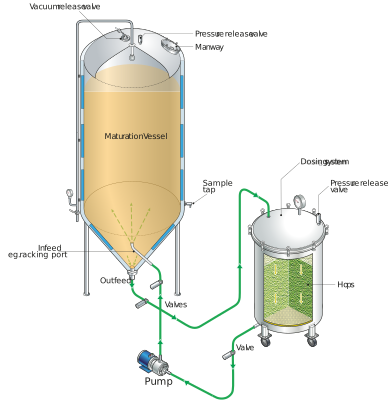
Figure: Process of continuous extraction
This illustration above shows the process of continuous extraction (hops in this case), which are retained in their separate vessel and not circulated in the fermentation/maturation vessel.
Crossflow filtration is now an established technology and has proven to be a superior filtration technology than kieselguhr filters. The main advantage over traditional filtration methods is the core principle of tangential flow as opposed to the static or ‘dead-end’ deep-bed filtration applied in classical DE filters. Therefore, the solid particles do not build up on the filter as they are removed continuously by the flowing retentate.
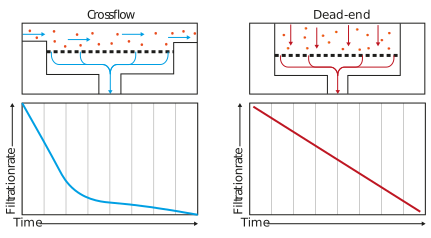
Figure: Crossflow and dead-end filtration
The other main advantage is that there is no requirement for a trap filter in a crossflow filtration system because the membrane filters are permanent barriers to microorganisms (pore size 0.45–0.65 μm). Also, there is no need for powder handling systems, no spent kieselguhr disposal costs and little operator intervention required because this is ‘black box’ technology, in other words, this is controlled effectively by automation. This sustainable method of filtration allows lower water usage and a lower carbon footprint.
This technology has evolved further, and some manufacturers using ceramic membranes rather than polyether sulfone (PES). The advantages of ceramic filters are that they have a 10-year shelf-life, the ability to remove polyphenols and β-glucans across the membrane, and typically deliver lower haze values.
However, there is a new technology, one that a brewer should consider to sit beside a crossflow filter as the next generation of filtration and stabilisation twinned technologies. CSS (controlled stabilisation system) is a solution for chill proofing; it consists of modular vessels containing a cross-linked agarose bead bed. The CSS stabilisation system is based on targeted adsorption of polyphenols and ensures effective beer stabilisation. The stabilising agent always remains within the system, unlike PVPP, when a small percentage is lost each time it is regenerated. Polyphenols are adsorbed by the agarose and are only removed from it again during regeneration.
The agarose does not have an adverse effect on other beer quality components. Therefore, the sensory characteristics, the foam stability, the beer colour, and the bitterness units of the beer does not change. In terms of operation, after primary filtration, a proportion of the filtered beer passes through the agarose bed, and polyphenols are adsorbed onto the beads. The proportion increases as the beads become saturated until primary filtration ends. The agarose bed is regenerated with caustic soda during the primary filter washout. The CSS system is said to be a cost-effective alternative to a regenerable PVPP plant.