
Lesson 3 - Warm and Cold Maturation SAQ
This lesson allows you to test yourself on the material covered in the Warm and Cold Maturation lesson, and determine the level to which you have met the learning outcomes.
Suggested Response - Q3
***Answer ALL parts of this question:
a) What haze forming units must a brewer remove during cold maturation, to avoid a non-biological haze?
b) Taking into consideration Stokes’ Law, how can a brewer influence the rate of sedimentation during cold maturation, to clarify beer?
c) Using the Stokes’ Law equation and values provided, how long will it take, in hours, for a yeast cell floc at the surface of the beer to sediment out in a tank of beer which is 6.5 m deep?
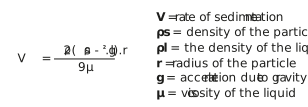
Density of yeast = 1140 kg/m3
Density of beer = 1017.36 kg/m3
Radius of yeast cell floc = 1.08x10⁻⁴ m
Acceleration due to gravity = 9.81 m/s2
Viscosity of beer = 1.25x10⁻³ kg/m.s
Response:
a) Haze forming units are removed during cold maturation to ensure long term colloidal stability, lowering the risk of haze formation during a beers shelf-life. The materials that create haze which a brewer must remove are:
-
Cross-linked proteins and polyphenols, which create a highly visible haze. These components are the primary reason for haze formation if not treated and removed during the maturation and filtration processes. An effective way to reduce these components is cold storage of -1 to -2 °C for 3-7 days, and the addition of haze stabilisation process aids.
-
β-glucans, which are less visible hazes but detectable in 90° haze meters. A brewer will stipulate low β-glucans in their malt and good malt modification (as a result β-glucans are broken down during the malting process) to minimise the risk of these components creating haze.
-
α-glucans are similar to β-glucans.
-
Pentosans, which are derived from wheat-based adjuncts but also found in malt if it is harvested in wet conditions.
-
Oxalate, which is calcium deficient worts. It is common practice for a brewer to add calcium to their grist bill, to enhance brewhouse and fermentation conditions, but this can also reduce the risk of calcium oxalate formation in the final pack. Calcium added in the brewhouse results in the formation of calcium oxalate in the vessel which precipitates out and removes the risk of haze formation and/or gushing in the final pack.
b) The rate of sedimentation is dictated by Stokes' Law. This describes the force required to move a sphere through a fluid at a particular velocity. In practice, a brewer aims to sediment out beer as quickly as possible during maturation.
A brewer can influence two main factors: particle size and gravitational force. The greatest of these is increasing the particle’s radius. By doubling a particle’s radius, the settling time would decrease fourfold. Increasing particle size is achieved by the use of process aids which adhere to the surface of haze forming units. This reaction creates a particle-process aid precipitation complex which increases the radius of the original particle.
The gravitational force can be increased by using a centrifuge. Beer is spun at a high velocity which increases particulate acceleration through gravity. Centrifugation is used in the reduction of yeast and suspended particles after fermentation and before cold storage and maturation.
c)
Density of yeast = 1140 kg/m3
Density of beer = 1017.36 kg/m3
Radius of yeast cell floc = 1.08 x 10⁻⁴ m
Acceleration due to gravity = 9.81 m/s2
Viscosity of beer = 1.25 x 10⁻³ kg/m.s
V = 2 (1140 kg/m3 – 1017.36 kg/m3) x (1.08 x 10-4)2 x 9.81
9 x 1.25 x 10-3 kg/m.s
Velocity of the yeast cell floc = 2.5 x 10⁻³ m/s
The beer depth is 6.5 m deep, therefore:
Time to sediment = height / velocity
Time to sediment = 6.5 m/2.5 x 10-3 m/s
Time to sediment = 0.72 hours