
Lesson 3 - Fermentation Principles SAQ
This lesson enables you to test yourself on the material covered in the Fermentation Principles lesson and determine to what level you have attained the outcomes.
Suggested Response - Q2
**Answer BOTH parts of this question:
a) Draw a labelled diagram showing the major phases in fermentation and briefly describe what is happening in each.
b) If a fermentation stops at an unexpectedly high gravity how would you test if the problem was related to wort composition or a failure in fermentation control?
Response:
a)
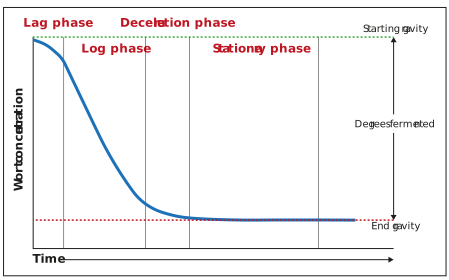
Figure: The major stages in fermentation
Usually four stages are recognised. This is not strictly true since the whole profile forms a smooth line but it is convenient to separate it into these phases to describe what is going on in each.
i. The lag phase is the initial stage where there is only a slight decrease in gravity. It is the period where the yeast is adjusting its genome to move into growth mode in response to exposure to warm oxygenated wort. It is adapting itself to shift from a resting state, adopted in the interval between cropping and re-pitching, to one of growth. In this stage most of the oxygen is taken up.
ii. The next phase is the log or exponential phase where growth rate reaches its maximum value. The growth rate is controlled by temperature. It is the period of maximum uptake of wort nutrients, decline in pH, and formation of alcohol and CO2.
iii. The deceleration phase marks the point at which yeast activity begins to slow down in response to the exhaustion of an essential nutrient or build-up of a product of yeast metabolism to inhibitory levels.
iv. The stationary phase is where yeast growth has stopped. It signals the time where the yeast is being starved or prevented from growing and, in response, moves back into the resting state.
b) Occasionally, fermentations stop before the expected final gravity is reached. There are several reasons why this might happen.
The problem might be wort-related. If the mashing process was not properly controlled the wort might be less fermentable than expected. On the other hand, the fermentation might not have been set up or controlled properly. Causes here would include things like failure to oxygenate the wort properly, very low pitching rate, low viability pitching yeast, or incorrect temperature control. These are just a few possible causes but there are others.
The first investigations would be to try and sort out whether or not it was a wort or a fermentation problem. This question can be easily answered by carrying out a fermentable residue test. Remove a small sample of the stuck fermentation, put it into a suitable container, and pitch it at a high rate with fresh yeast. Shake to get some air into it and, after checking the gravity, leave overnight.
Re-check the gravity the next day. If it has not changed, the wort must be fully attenuated and so the problem was wort-related. If the gravity has dropped to the expected final gravity the initial problem must have been a result of lack of proper fermentation control.