
Lesson 1 - Introduction to Fermentation
This lesson introduces the Fermentation Unit. It provides a brief summary of what we are going to cover in the rest of the unit.
What You Will Study in the Fermentation Unit
This section provides an overview of what we will study in the lessons.
During the unit we will learn how to:
● Draw a diagram that shows the main phases in a typical brewery fermentation and describe what is happening at each stage.
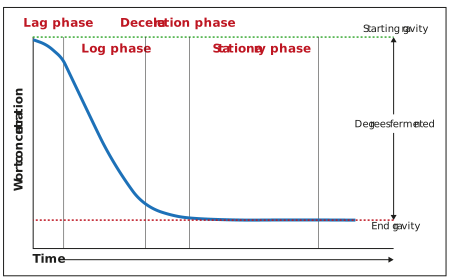
Figure: Stages in fermentation
● Describe, with suitable drawings, changes during fermentation in wort gravity, dissolved oxygen, pH, free amino nitrogen, CO2, and yeast concentration.
● Give a mass balance of fermentation.
● List the key features that are used to assess the successful outcome of fermentation.
● List the major fermentation variables and describe how they influence fermentation progression and performance.
● Describe the practice of high gravity brewing and discuss the reasons for its adoption by many brewers.
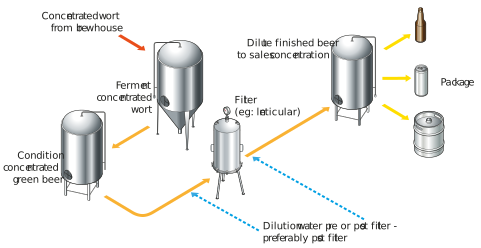
Figure: Schematic showing process steps for high gravity brewing
● Discuss the various ways in which yeast influences beer flavour.
● List the major groups of compounds produced by yeast as it grows on wort and transforms it into beer and give typical concentrations at which they arise.
Table: Major flavour-active groups of compounds produced by yeast in fermentation
|
Alcohol (ethanol) |
|
CO2 |
|
Organic acids |
|
Aldehydes |
|
Fatty acids |
|
Higher alcohols (fusel alcohols) |
|
Esters |
|
Sulphur compounds |
● Describe the metabolic pathways used by yeast to form the major groups of yeast-derived flavour compounds and discuss why they are present.
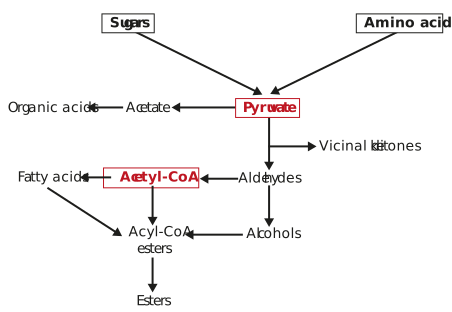
Figure: Relationships between formation of flavour compounds and intermediary metabolism
● Describe how spontaneous fermentations are carried out and give examples of beer styles in which they are used.
● Discuss the microbiology of spontaneous fermentations and describe some of the unusual fermentation products formed.
● List the requirements of fermentation vessels for the production of beer.
● Describe the materials used to construct fermentation vessels and assess their strengths and weaknesses.
● Describe, with suitable drawings, the design of fermentation vessels suitable for both top- and bottom-cropping yeast strains.
Table: Properties of some closed-design fermenting vessels
|
Type |
Comments |
|
Closed box |
● Inexpensive to build ● Can be stacked on separate floors of a building ● Yeast crop retained by upstand but difficult to remove ● Poor draining properties |
|
Horizontal cylinder |
● Relatively inexpensive ● Avoids tall hydrostatic head ● Difficult to empty and remove yeast crop ● Can be stacked to minimise footprint |
|
Vertical cylinder |
● Relatively inexpensive ● Easily arranged in tank farms ● Efficient cleaning ● Good draining properties ● Cropping not as efficient as coned vessels |
|
Spheroconicals |
● Excellent mixing ● Most efficient design for external cooling ● Efficient cropping ● Very expensive to build |
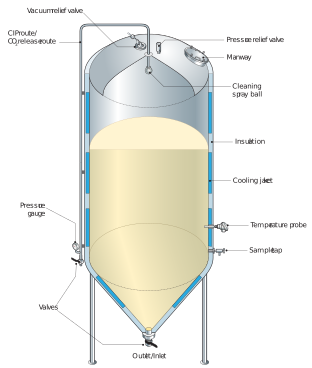
Figure: Principal features of a cylindroconical fermenter
● Understand the requirements of fermentation rooms for use with top and bottom yeast cropping.
● Identify the selection criteria used to choose fermenter numbers and capacities.
● Describe practices used during fermenter fill and discuss methods of wort cooling, pitching, and aeration or oxygenation.
● Describe how fermentations are controlled.
● Discuss the process of combined fermentation and cold conditioning and compare the advantages and disadvantages of this approach with those of a two-tank approach.
● Understand the theory that underpins continuous fermentation.
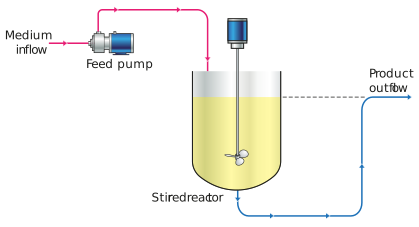
Figure: Illustration showing the principle of a chemostat
● Critically assess the benefits and drawbacks of continuous brewing fermentation.
● Describe continuous fermentation systems developed for commercial brewing.