
Lesson 9 - Yeast Management SAQ
This lesson enables you to test yourself on the material covered in the Yeast Management lesson, and the level to which you have met the learning outcomes.
Suggested Response - Q5
**Answer all three parts of this question.
a) With the aid of a suitable diagram describe the elements of a system suitable for the automatic control of yeast pitching using a sensor which utilises the dielectric properties of cells.
b) Describe how the sensor works?
c) What are the advantages and disadvantages of this automatic system?
Response:
a) The system has three parts as shown in the flowing diagram:
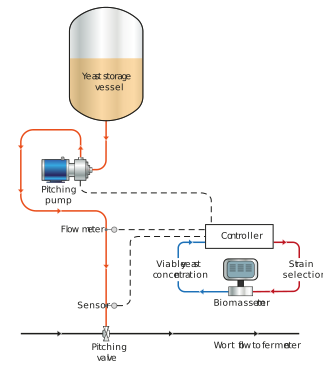
Figure: Outline of the components of an automatic control system for yeast pitching
i. Yeast sensor: The sensor measures the viable concentration of yeast cells and feeds this back to the yeast biomass meter. The sensor is located in the pipe (the yeast pitching main) which runs from the yeast storage tank to the pipe carrying the cooled wort into the fermenter. The sensor measures the viable yeast concentration passing before it at any instant in time.
ii. A flow meter is also located in the yeast pitching main. The output from this, together with the yeast concentration reading, allows the automatic calculation of the total number of yeast cells which have passed by the sensor.
iii. As the name suggests, a controller oversees the process. It chooses the appropriate calibration for the yeast strain being pitched. It compares the number of cells transferred into the yeast, and when this meets a target based on the desired pitching rate and the wort volume, the system automatically turns off the pitching pump and the yeast pump.
b) The sensor makes use of the dielectric properties of cells. The cell membrane is composed mainly of lipids and is a poor conductor of electrical currents. However, it can build-up and hold a charge when it is suspended in a medium that contains charged species, such as wort or beer, and through which an electrical current is passed.
The build-up of charge on the membrane can be measured as capacitance. The value of the measured capacitance is equal to the surface area of the membrane within the operating field that is generated by the sensor. In the calibration process, this can be related directly to the total number of cells in the operating field.
Yeast cells that are classed as non-viable by standard brewery tests, such as staining with methylene blue, do not have intact or functional cell membranes. Cells with disrupted membranes are not able to build-up a capacitance and are therefore not detected by the sensor. Similarly, non-yeast solids such as trub and also gas bubbles, are not able to hold a charge and as with dead cells, are not detected by the sensor.
c) The main advantage of this system is that it produces very reproducible results. It has been demonstrated that, compared to the pitching rate control based on sampling and off-line analysis of yeast, it produces much more consistent fermentation performance.
The costs of its purchase and operation are off-set by the skilled workforce savings needed for laboratory analyses of yeast.
If used in combination with the control of yeast cropping, it can be used as part of a total yeast management system automatically tracking how much yeast there is in the brewery, where it came from, where it went to and how often it has been pitched.
A disadvantage is cost, and this can only really be justified for larger breweries. It requires calibration for each strain used, and the calibration must be checked at intervals which off-sets some of the gains made in loss of the skilled workforce.
The calibration requires using yeast suspensions of known viable yeast concentration. Since there is no such thing as a yeast standard, as there might be for other sensors, the absolute precision of the sensor cannot be any better than the precision of the analysis used to make the calibrating yeast suspension.
The sensor detects viable cells but not those that are non-viable, which means it cannot measure viability. This is an important distinction. In use, the system will continue to pitch yeast until it reaches the target for total viable cells. This is independent of the viability, and if this is low, it will merely pitch a greater total quantity of yeast. In other words, it does not indicate the quality of the pitching yeast. Of course, it is possible to monitor the total quantity of yeast transferred, and if this exceeds a given expected value, this can trigger an alarm.