
Lesson 9 - Yeast Management SAQ
This lesson enables you to test yourself on the material covered in the Yeast Management lesson, and the level to which you have met the learning outcomes.
Suggested Response - Q2
* Answer both parts of this question.
a) Draw a diagram showing a vessel suitable for storing pitching yeast cropped from the base of a cylindroconical fermenter. Describe the key features of the vessel.
b) How might you change the storage method if your brewery introduced very high gravity brewing?
Response:
a) Yeast cropped from this type of fermenter will be in the form of a slurry of cells suspended in beer. The following diagram shows the features of a vessel suitable for storing pitching yeast slurry.
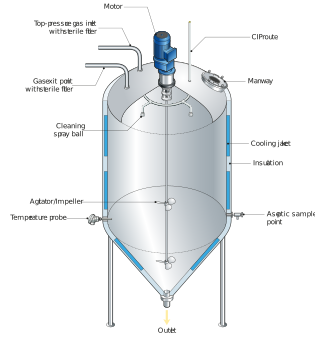
Figure: features of a storage vessel for pitching yeast slurry
A key feature is hygiene since contamination of pitching yeast will have catastrophic consequences. The CIP system should be single-use, and the vessel must be designed for ease of cleaning, without blind spots. Gas inlets and outlets must be fitted with microbiological filters and must be prevented from getting wet, which can affect their effectiveness. Similarly, any fitting that projects into the vessel must be designed with hygiene in mind. Of particular note is the sample tap; these are common sources of hygiene problems and must be designed so that they can be cleaned and sterilised before and after use.
It is important to ensure that the temperature of the slurry is held at the specified value, typically 2-4 ºC. Usually, these tanks are only designed to hold at a given cool temperature (not to actively chill warm yeast), so external cooling jackets are satisfactory. However, the yeast cells must not be allowed to settle out and so a gentle method of mixing is provided to prevent this from happening. This helps with heat transfer and also ensures that samples are representative of the whole.
Air should be excluded from the vessel as oxygen will trigger the rapid breakdown of intracellular glycogen stores, and thereby reduce the storage potential of the yeast. This is prevented by top pressuring the vessels with nitrogen or CO2.
It is necessary to be able to gauge how much slurry is contained in the vessel so either load cells or a flow meter should be fitted.
b) The move to very high gravity brewing will increase the stress level of the yeast as a result of the higher alcohol concentrations of the beer. This reduces the storage potential of the yeast, but the effect can be avoided by diluting the slurry with sterile de-aerated brewing water. Storage vessels must have the capacity to cope with the additional volume. Commonly, very high gravity fermentations are cropped warm before the beer is chilled. In this case, it is preferable to install an in-line chiller to lighten the load on the cooling of the yeast storage vessel.