
Lesson 8 - Wort Separation Final SAQ
This lesson allows you to test yourself on the material covered in all previous ‘Wort Separation’ lessons, and determine the level to which you have attained the outcomes.
Suggested Response - Q2
***Your lauter tun is the rate limiting step in the brewhouse. It is rated at 10 brews per day, with a cycle time of 144 min. Current cycle time is 10 min longer than this. Demonstrate the impact of this on brewhouse capacity. How would you investigate, and remedy, this situation?
Response:
The lauter tun is rated at 10 brews per day – a cycle time of 144 min.
Current cycle time is 154 min – a daily output is 1,440 min/154 min = 9.35 brews per day.
Capacity reduction (10 - 9.35)/10*100 = 6.5%.
Darcy’s Law shows us the variables that affect strong worts separation flow Q.

In a given situation, the cross-sectional area A, the bed depth L, and the DP are fixed. A reduction in flow rate could be due to reduced grain bed permeability K and/or increased viscosity μ.
Go through a troubleshooting review of the process, to identify where K and μ might have changed.
Reduced Grain Bed Permeability
For a grain bed to have lower permeability, the husk fraction will be lower than standard. A plansifter analysis will reveal whether this is the case. Adjustment of roller mill gaps can correct for any variation. A lauter tun grist husk fraction (sieve one and sieve two) will be approximately 25%.
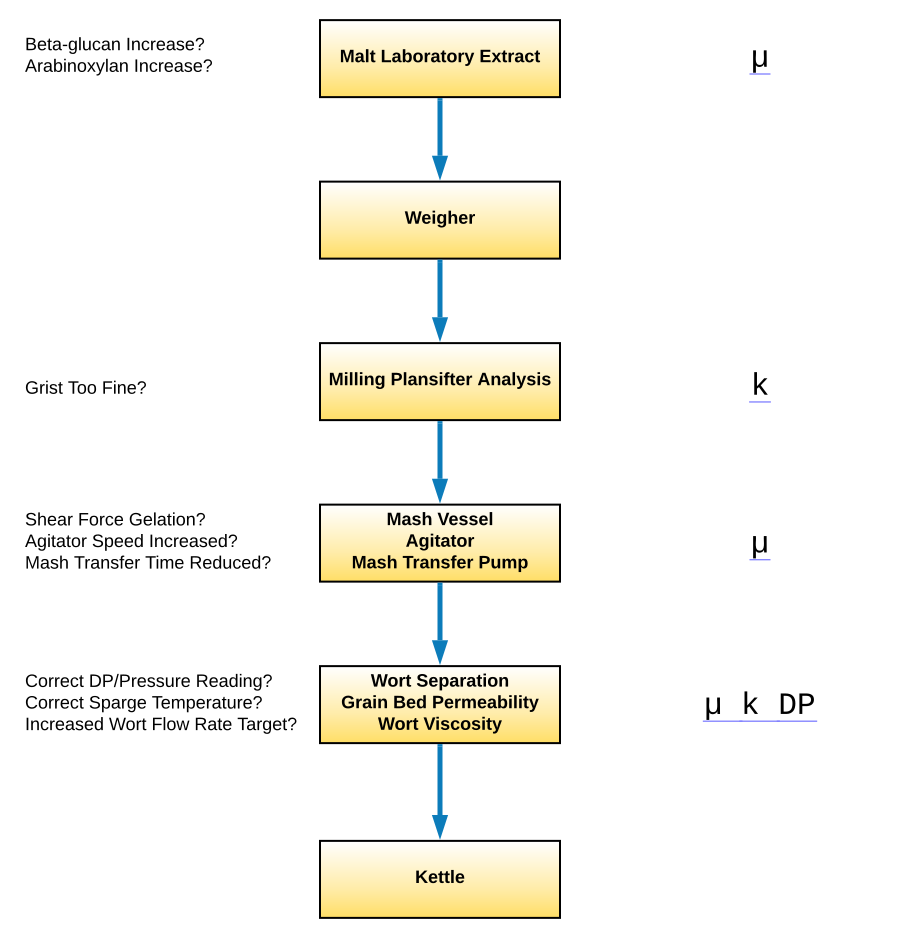
Figure: Troubleshooting slow wort separation
Increased Wort Viscosity
Higher gravity and lower temperature will increase wort viscosity. For a given recipe, these are fixed by the mashing water:grist ratio, and the mash temperature profile. However, the same gravity and temperature wort can have a higher viscosity due to increased levels of β-glucan and arabinoxylan in the malt. This is due to lower modification of the barley endosperm at malting, where the β-glucan level decreases from around 2% to 0.2%. Any change in β-glucan content will be revealed by the malt certificate of analysis.
If heat stable β-glucanase is being used in the mash vessel to reduce wort viscosity, check that the addition rate has not been changed, and that the correct amount is being dispensed.
The same gravity and temperature wort can have a higher viscosity due to gelation of β-glucans and proteins, by subjecting the mash to high shear forces. It is important to confirm that operational parameters affecting this have not been changed.
Increased shear of the mash can happen if the speed of the mash vessel agitator has been increased, or has changed from intermittent mixing to continuous mixing. The tip speed of the agitator should not exceed 2.5 m/s. Increased shear of the mash can happen if the speed of mash transfer has been increased due to the mash pump impeller running faster. The impellor speed should be < 1000 rpm. The faster mash transfer will also mean higher velocity in the pipework, which will increase shearing, particularly if there are any sharp changes in direction. Mash transfer velocity should be < 1.5 m/s and change of direction should be by large radius bends.
A lauter tun wort at SG 1.075 or 18.1 ˚Plato would typically have a viscosity of 1.25 cP (this will be 3.38 cP if measured at 20˚C).
A reduction in sparge temperature will increase viscosity. We need to confirm that sparge target temperature has not been reduced and that the temperature probe is accurate (probe calibration).