
Lesson 8 - Wort Separation Final SAQ
This lesson allows you to test yourself on the material covered in all previous ‘Wort Separation’ lessons, and determine the level to which you have attained the outcomes.
Suggested Response - Q1
***Extract efficiency from your mash filter is running low. From the given data below, calculate the actual current extract efficiency – show your workings. Explain how you would investigate and remedy the situation.
The Mash Filter is producing 475 hL of wort at 1.060 Specific Gravity and 14.68 ˚Plato.
Mass of malt used = 10,000 kg.
Malt extract dry = 82% w/w or 316.6 L˚/kg.
Malt moisture = 5% w/w.
Density of water at 20˚C = 0.9982 kg/L.
Response:
Firstly, calculate the extract efficiency being achieved. Use the method that you are most familiar with.
Kg Extract Method
We are told that the coarse grind dry basis extract of our malt is 82% w/w (82 kg/100 kg), and that the moisture content is 5% w/w (5 kg/100 kg).
Therefore, we first need to work out what the extract weight of our malt is by removing the 5% moisture.
10,000 kg - 500 kg = 9,500 kg.
We are told that 82% of this dry weight is extract, so we can work out the extract weight added now as:
9,500 kg / 100 X 82 = 7,790 kg
We are told that we have produced 475 hL of wort at SG 1.060 at 14.68 ˚Plato.
The SG needs to be converted to density by correcting for the density of water at 20˚C, which we are told is 0.9982 kg/L.
Wort density = SG x 0.9982 kg/L = 1. 060 x 0.9982 kg/L = 1.058 kg/L.
Extract recovered = hL X density X ˚Plato
475 x 1.058 x 14.68 = 7,377.4 kg.
Extract efficiency is kg extract recovered as a percentage of kg extract added.
Extract efficiency is (7,377.4 kg/7,790 kg) x 100 = 94.70 %.
L˚ extract method
We are told that the coarse grind malt dry basis extract is 316.6 L˚/kg and that our moisture is 5% w/w.
The extract weight is therefore 316.6 x 0.95 = 300.77 L˚/kg.
300.77 L˚/kg = 300.77 /100 hL˚/kg = 3.0077 hL˚/kg.
We have used 10,000 kg of malt at 3.0077 hL˚/kg.
Extract added is 10,000 kg x 3.0077 hL˚/kg = 30,077 hL˚
We have produced 475 hL of wort at SG 1.060 or 60˚ gravity.
Extract recovered is 475 hL x 60˚ = 28,500 hL˚
Extract efficiency is the recovered hL˚ extract as a percentage of the added hL˚ extract.
Extract efficiency is 28,500/30,077 x 100 = 94.75%.
Use a trouble shooting technique to identify whether the low extract efficiency is due to incomplete mash conversion, or incomplete mash separation.
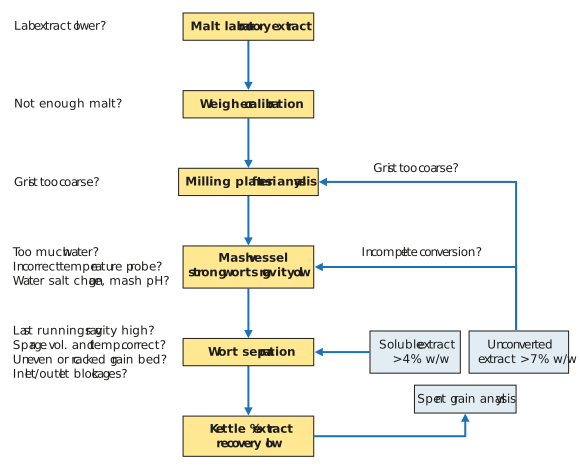
Figure: Troubleshooting for low extract recovery
Incomplete Conversion
If a known quantity of extract is added to a known volume of water, then this will result in a specific mash wort gravity. If mash conversion is incomplete, then this will show as a low mash wort gravity, and should be investigated.
Check inputs – has the extract of the malt changed (certificate of analysis)? Has the correct weight of malt been added (weigher calibration, stock control discrepancies)? Has the correct volume of water been added (meter calibration)?
Check process – Is the husk fraction coarser than normal (plansifter)? Have the hammer mill sieve sizes changed? Is the mash temperature correct (calibration)? Is the mash pH normal (water composition)?
Incomplete Wort Separation.
If wort separation is not complete, then this is due to inefficient sparging. This will show as an elevated last runnings wort gravity (greater than SG 1.006). It will also show elevated levels of soluble extract in the spent grain (greater than 0.5 %w/w).
Inefficient sparging arises from preferential flow of sparge water in different areas of the grain bed. The grain bed needs to be evenly distributed, and have no cracks. During mash filter filling, the chambers need to feed evenly, so that at the end of mash transfer there is the same quantity of grain in each chamber. During the transition from pre-compression to sparge, there must be no loss of forward flow, which could allow grain movement and bed cracking. During sparging, the water will preferentially flow through the chambers which present least resistance e.g. those with lower charges of grain or cracked grain beds.
A spent grain discharge needs to be observed for signs of any chambers with thin or cracked grain beds. Each filter plate needs to be checked for blockages. The mash inlets need to be clear. The wort outlets (behind the filter cloths) need to be clear.