
Lesson 3 - Mashing Biochemistry SAQ
This lesson provides the opportunity for you to test yourself on the material covered in Lesson 2, Mashing Biochemistry and determine the level to which you have attained the expected outcomes.
SAQ Suggested Response - Q1
* Using diagrams, show an α-(1,4) glycosidic bond and how it differs from an α-(1,6) bond and a β-(1,4) bond.
Response
An α-(1,4) and α-(1,6) glycosidic bond are shown below; these are called glycosidic bonds, as they link glucose residues which are also called glycosides.
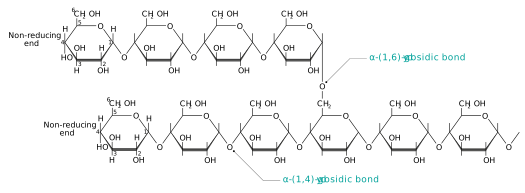
Figure: Amylopectin showing glycosidic bonds
The α-(1,4) bond is between the carbon-1 and carbon-4 atoms on adjacent glucose residues. The α-(1,6) bond is between the carbon-1 and carbon-6 atoms of adjacent glucose residues.
There are two types of bonds between glucose residues: the α- and the β- glycosidic bond. Glucose can exist as both an α and β isomer based on the relative positions of the groups of atoms connected to carbon atom number 1.
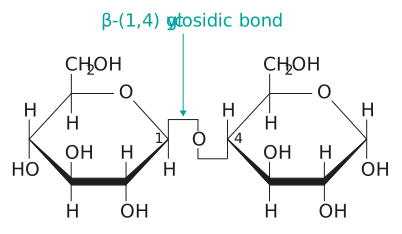
Figure: Cereal β-glucan structure showing the β-glycosidic bond
When an α-(1,4) glycosidic bond is made, the hydroxyl (OH) group shown below carbon number 1 (the hemiacetal group) on the glucose molecule to the left is removed to form water with the hydrogen (H) from carbon 4 of the other glucose molecule. When a β-(1,4) glycosidic bond is formed, the hydroxyl group shown above carbon number 1 on the glucose molecule to the left is removed to form water with the hydrogen from carbon 4 of the other glucose molecule. Drawing and describing it this way makes it easier to understand, but in reality, the position of the hydroxyl group is relative to the plane of the glucose molecule rather than carbon number 1.