
Lesson 3 - Hop Biology and Cultivation SAQ
This lesson provides the opportunity for you to test yourself on the material covered in Lesson 2 (Hop Biology and Cultivation) and determine the level to which you have attained the expected outcomes.
Suggested Response - Q4
** Give an overview of the hop growing cycle, from the point of shoots appearing, through to dormancy. Provide timelines and use diagrams to help explain.
Response:
Before hops begin to shoot, there needs to be a supporting framework for the hops to grow on. The diagram below shows a supporting framework, or trellis, used for the hop to grow on.
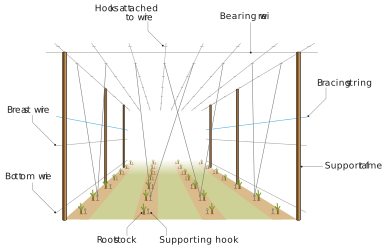
The hop growing cycle starts in early April and goes through until harvest between the end of August and late September.
The first shoots come through in April. Two or three of these shoots are then trained on the wire or twine support; the rest of the shoots are removed. The shoots will then wind themselves around the wire/twine in a clockwise direction and grow at a rapid rate – as much as 30 cm in a day. During this rapid growth phase, the soil must be kept at optimum conditions to support this growth. This involves maintaining a pH of 6.5, and fertilising with nitrogen, potassium and phosphate. The plants also need to be irrigated.
The hops should reach the top of the trellis by the end of July, and the lateral stems will then grow outwards. It is important to inspect the plants for pests and diseases, controlling any visible infestations.
Harvest occurs between the end of August and the end of September. Once the cones have been harvested, the remaining parts of the hop plant begin to wither. It is then cut back down to the rootstock. Movement of food for the plant goes into the rootstock, to provide it with the energy and nutrients needed for growth in the spring. This period is known as dormancy.