
Lesson 5 - Malting Process SAQ
This lesson provides the opportunity for you to test yourself on the material covered in Lesson 4 (Malting Process) and determine the level to which you have attained the expected outcomes.
Suggested Response - Q4
SAQ:
**Look at the diagram below. Firstly, identify the control parameters available to you to control the process. Then, evaluate the impact of these parameters on the process.
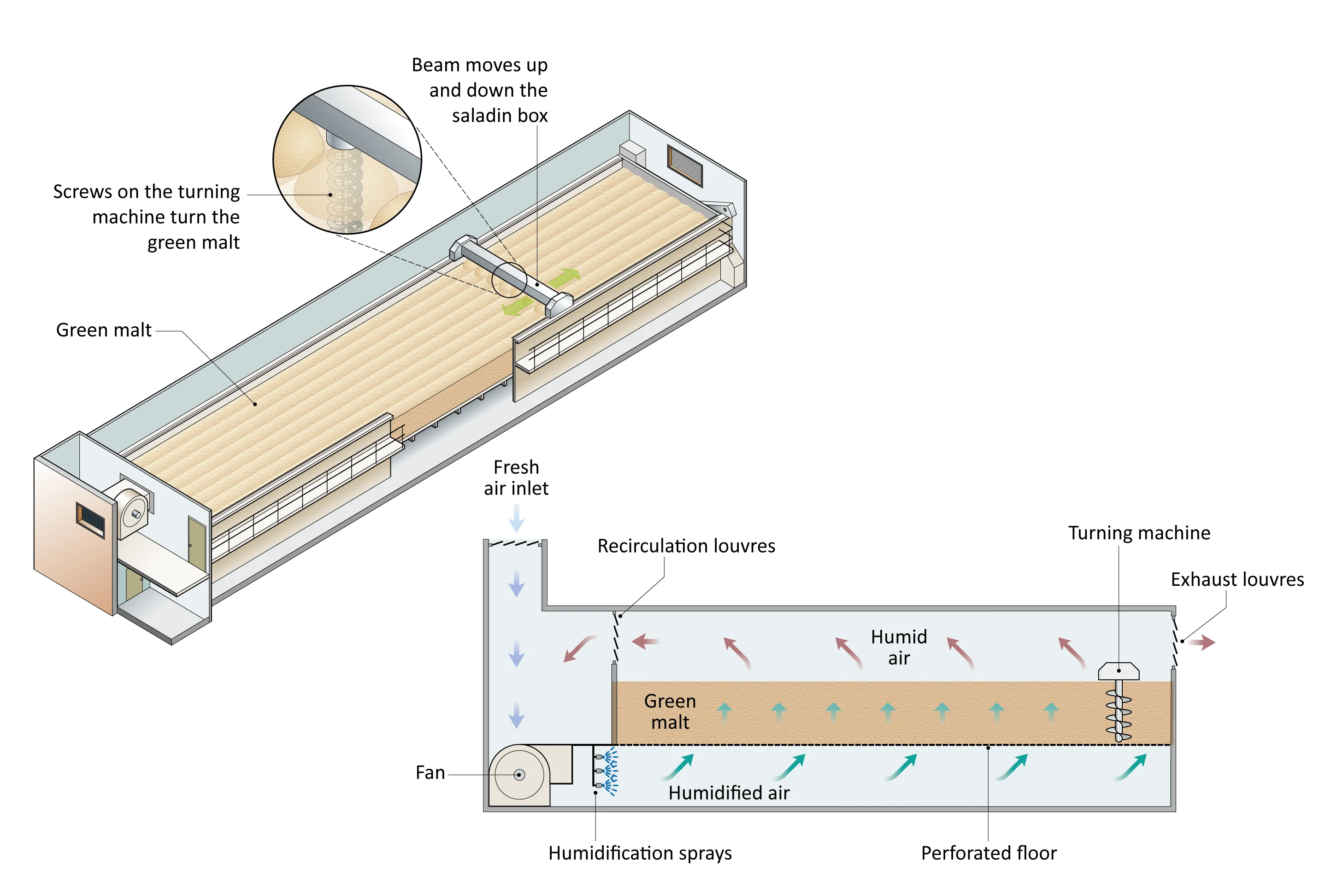
Response:
In the germination process, temperature and moisture are the control parameters.
Temperature
Temperature and modification are directly proportional, but within limits. The higher the temperature, the faster the modification.
Temperature impacts enzymes. Within limits, the higher the temperature, the higher the rate of enzyme activity. However, not all enzymes work at the same temperature. The optimum temperature for one might denature (inactivate) the next.
Proteases and amylases are important for modification. These enzymes are produced during steeping and germination. The impact on proteases is as follows:
- A high starting temperature suppresses protease activity.
- A low starting temperature enhances protease activity.
Moisture
Moisture and modification are also directly proportional, but again within limits. Above 47% moisture, germination will be inhibited (slowed down). We must also be careful not to drown the grain.
The higher moisture level of green malt promotes amylase and protease formation. Restricting moisture content promotes  -glucanase formation. By controlling moisture and temperature, you can create the best balance of enzymes required for modification as well as for brewing.